

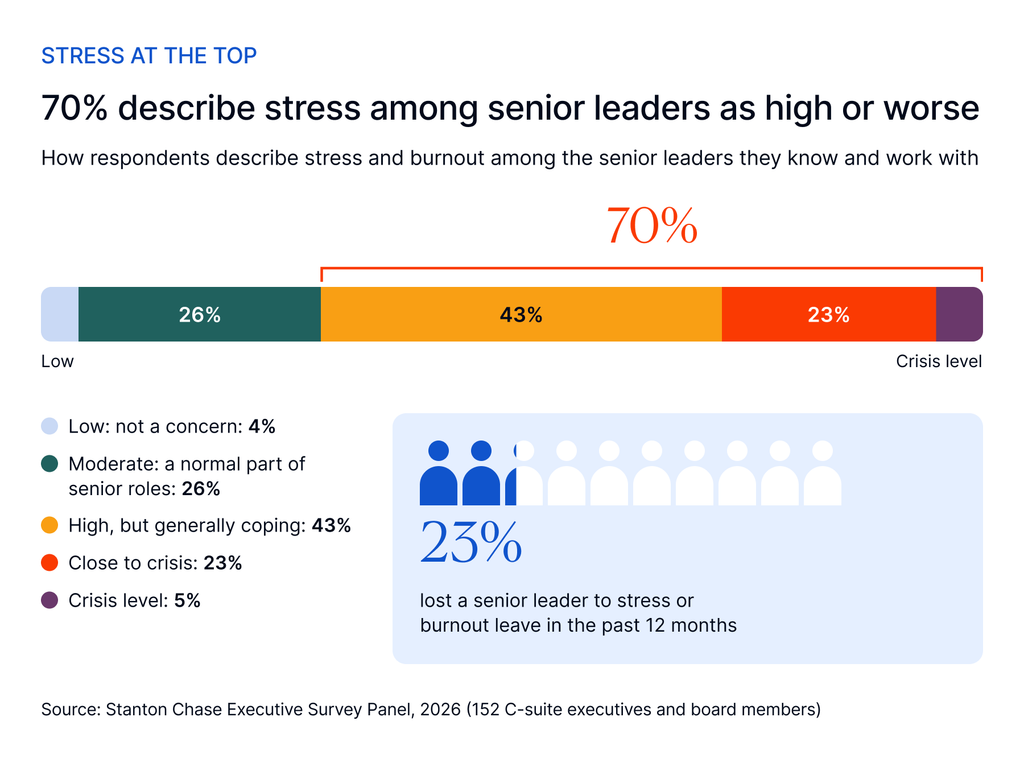
Stanton Chase asked 152 C-suite executives and board members from its Executive Survey Panel about resilience in late 2026. Seventy percent describe stress among the senior leaders they know as high or worse, and 23% lost a senior leader to stress or burnout in the past 12 months. Constant change with no time to recover was the most common barrier to resilience (49%), and long working hours came last (10%). Although 88% say their leadership team could run the business well or well enough for four weeks without them, only 27% of that group take holidays where they fully disconnect.
Leaders in our survey name having no time to recover as the biggest barrier to resilience, yet almost none mention rest when they describe a resilient executive.
That mismatch comes from a Stanton Chase survey of our Executive Survey Panel, which members answered in October and November 2026. We asked C-suite executives and board members to rate stress among the senior leaders they know, describe what resilience looks like, name what makes it hardest for executives to stay resilient, and tell us how they manage pressure themselves. Their answers on rest raise a question worth asking before the holidays. Of the 88% who believe their team could run the business for four weeks without them, only 27% take holidays where they fully disconnect.
How Stressed Are Senior Leaders Going Into 2027?
We began with stress among the leaders our respondents know and work with. Seven in 10 respondents (70%) rate stress and burnout among the senior leaders they know as high or worse. Nearly a quarter (23%) say leaders are close to crisis. Another 5% see a crisis already under way. Only 4% say stress is not a concern.
These answers describe other people. That was deliberate. Executives tend to rate their own health generously. A December 2025 survey by Calm found that 87% of C-suite leaders rated their mental and emotional health as good or better. Yet 41% of the same leaders reported trouble sleeping. Asking about peers gave our respondents more room to be candid.
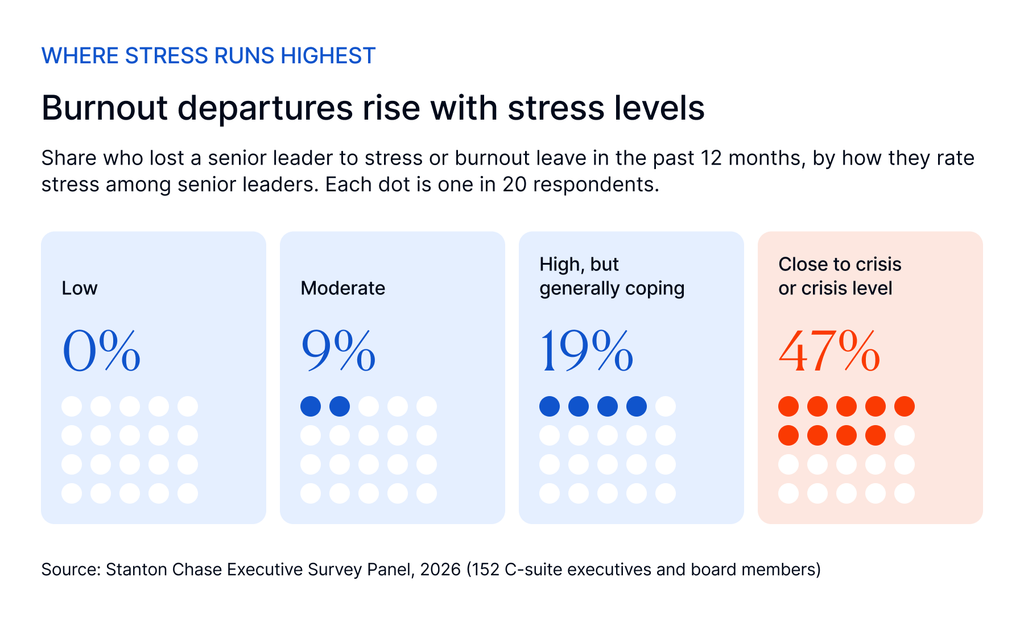
What they see is already costing organizations senior people. Nearly one in four respondents (23%) lost a senior leader in the past 12 months. That leader left or took long-term leave, mainly because of stress or burnout. For 6%, it happened more than once. These departures cluster where stress runs highest. Among respondents who rate stress as close to crisis or at crisis level, 47% lost a senior leader this way, compared with 19% of those who call stress high, but generally coping, and 9% of those who call it moderate.
What Do Executives Think Resilience Looks Like?
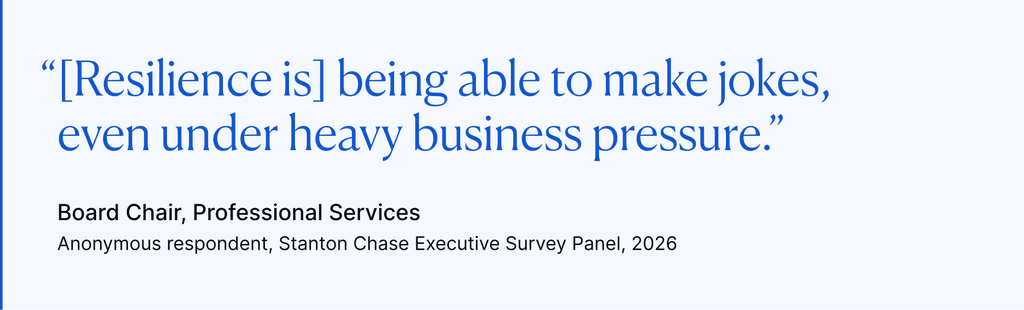
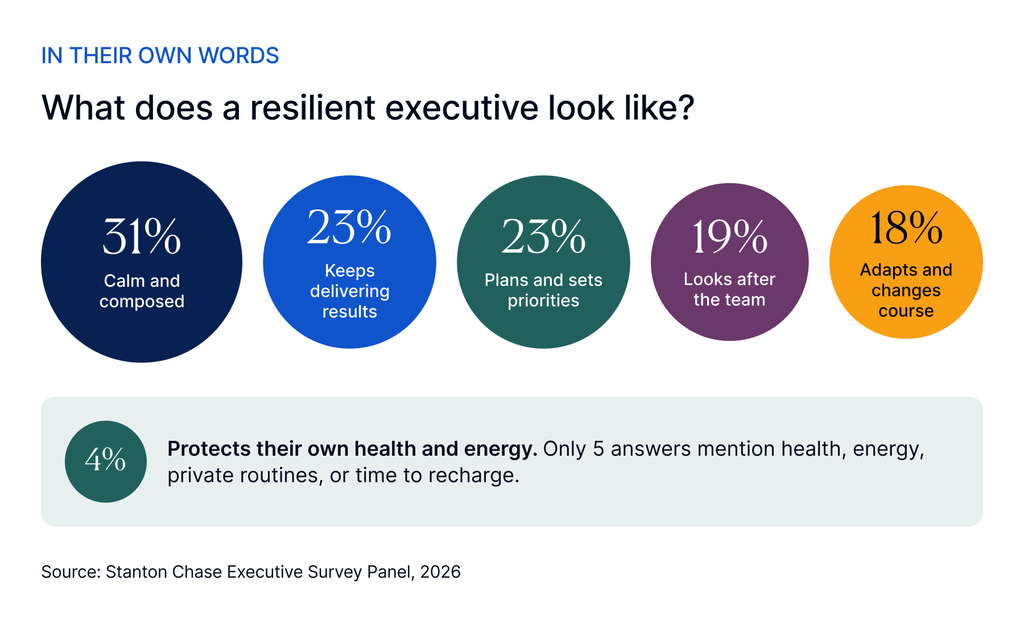
Next, we asked what resilience looks like. Respondents described the clearest sign of a resilient executive in their own words. We grouped the usable answers by theme. About a third (31%) described some form of calm, such as staying composed or keeping a clear head. Others pointed to steady delivery of results (23%), clear plans and priorities (23%), care for the team (19%), and the ability to adapt or change course (18%).
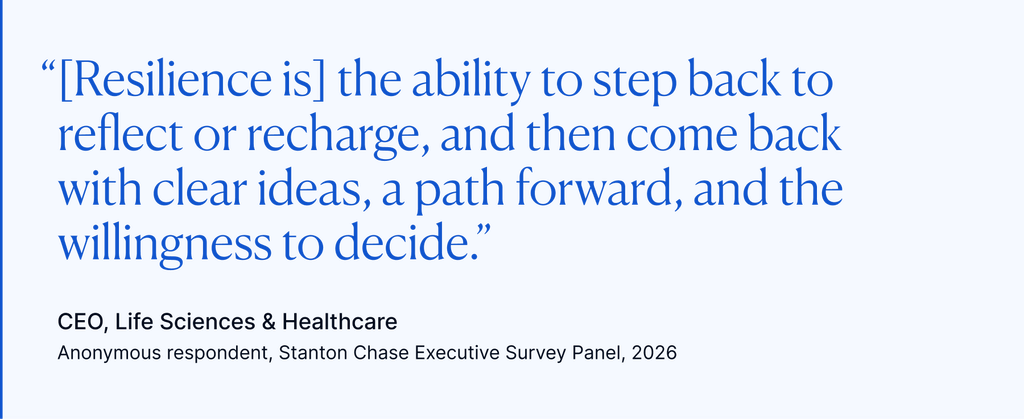
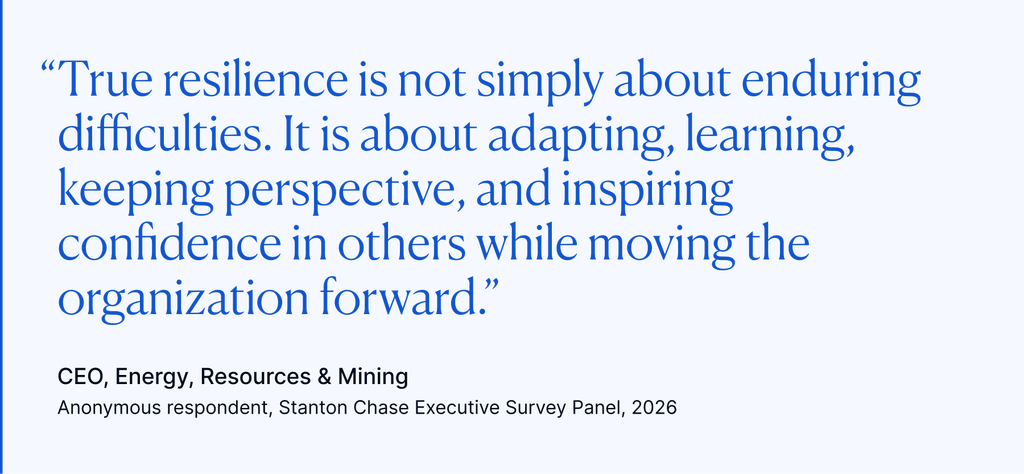
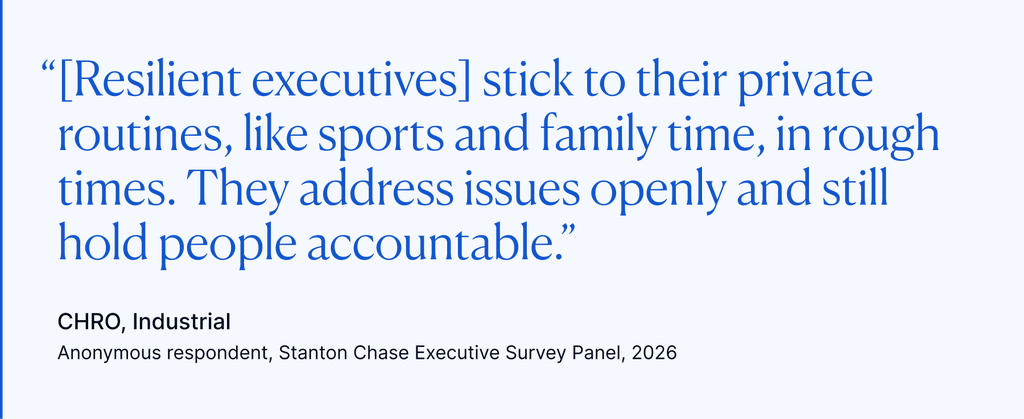
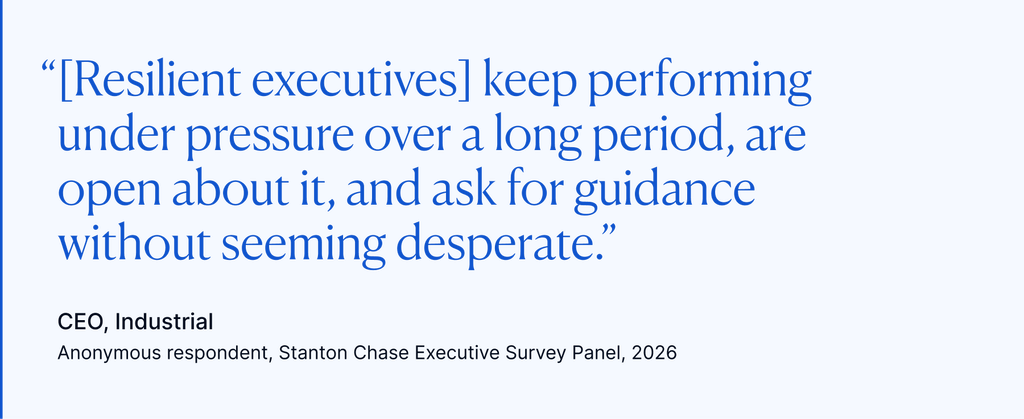
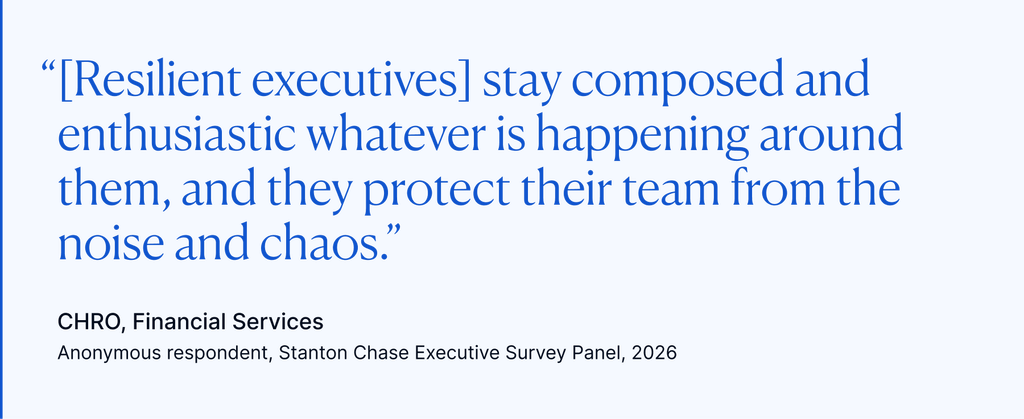
Very few of those answers mention recovery. Only five referred to health, energy, private routines, or time to recharge. One CEO named the ability to step back, reflect, and recharge. A CHRO in the industrial sector praised leaders who keep up sports and family time in rough periods. The other answers describe things colleagues can see, such as composure and results, and say almost nothing about what happens when nobody is watching.
What Makes It Hardest for Executives to Stay Resilient?
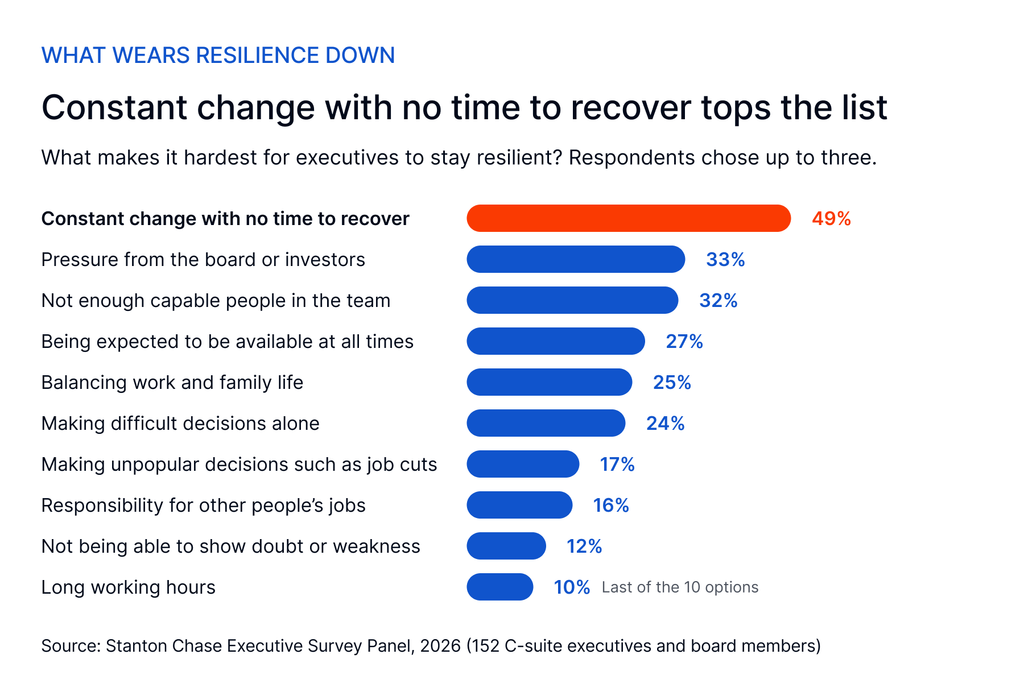
Recovery is missing from how leaders define resilience. Yet a lack of time to recover tops the list of what wears resilience away. Asked to pick up to three things that make resilience hardest, nearly half (49%) chose constant change with no time to recover. Board or investor pressure came second at 33%. Not having enough capable people in the team followed closely at 32%. Being expected to be available at all times came next at 27%.
Long working hours came last of the 10 listed options, at 10%. Our panel seems to accept the length of the job. What wears leaders down is a pace that never pauses long enough to recover from it. Among leaders who see stress close to crisis or worse, 62% name constant change as a barrier, compared with 49% of all respondents.
Other recent research describes the same relentless pace. Microsoft’s 2025 Work Trend Index found that 52% of leaders say their work feels chaotic and fragmented, and that by 10 p.m., 29% of active workers are back in their inboxes. BCG’s CEO Insomnia Index surveyed 645 CEOs in mid-2026. Nearly half often or very often put off activities that support their physical and mental well-being.
How Do C-Suite Leaders Manage Pressure and Stay Well?
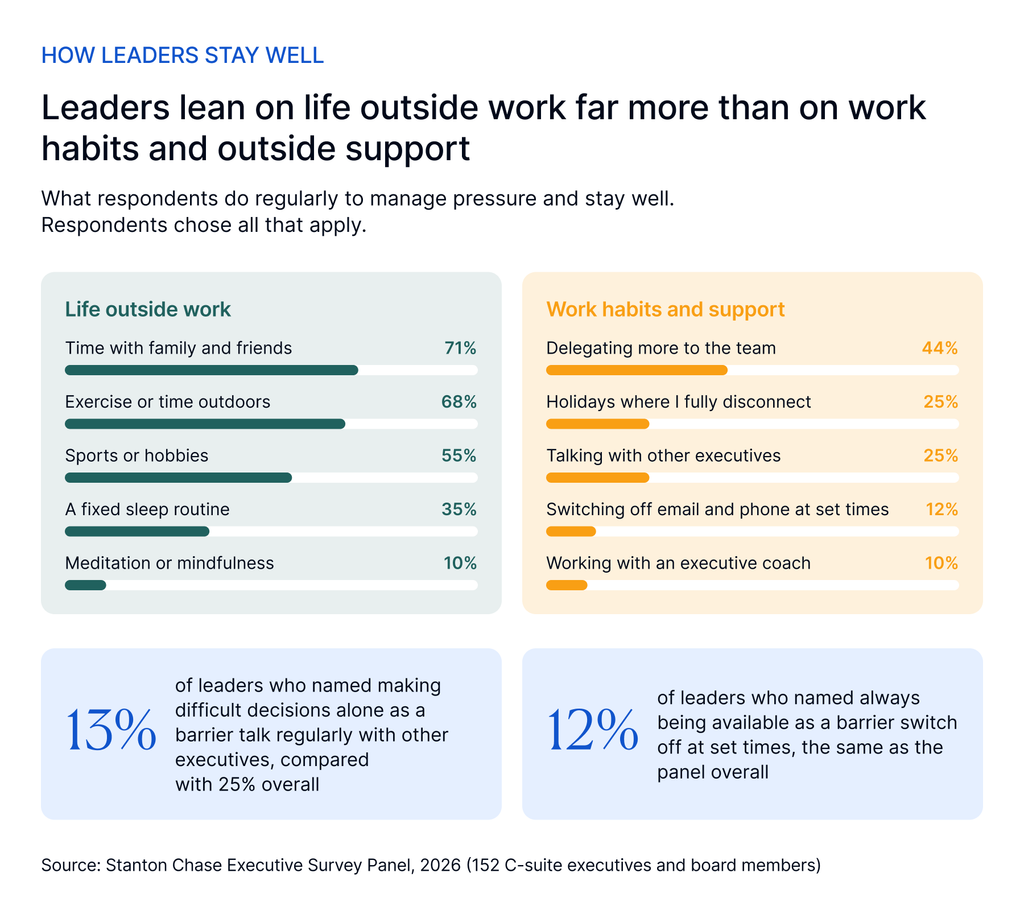
Given that pressure, we asked what respondents do regularly to stay well. Their answers lean on life outside the office. Time with family and friends (71%) and regular exercise or time outdoors (68%) lead the list, followed by sports or hobbies (55%), while just over a third of respondents (35%) keep to a fixed sleep routine.
Changes to how they work are less common. Delegating more is the most common, at 44%. A quarter (25%) take holidays where they fully disconnect, and only 12% switch off email and phone at set times. Support from outside the company is also uncommon, with 25% talking regularly with other executives and 10% working with an executive coach. CEOs limit their availability least often of any group. Just 7% switch off at set times, and 20% fully disconnect on holiday.
Some of these habits sit oddly next to the barriers the same leaders named. Take the leaders who named making difficult decisions alone as a barrier. Only 13% of them talk regularly with other executives, compared with 25% of all respondents, and 7% work with a coach. Leaders who named being expected to be available at all times are no more likely than the panel as a whole to switch off email and phone at set times, at 12% in both cases. Our respondents can name what drains them with precision, yet many leave it in place.
How Does the Leadership Team Affect Executive Burnout?
Those habits treat resilience as a personal matter. Our data says the team matters too. Not having enough capable people in the team was the third most common barrier to resilience, at 32%. Among CEOs, it ranks second, at 39%.
A senior role filled by the wrong person adds load to everyone else on the team. Outside our panel, BCG’s Insomnia Index found that nearly 60% of CEOs plan to replace a senior team member within six months.
If capable people around a leader ease the pressure, resilience planning might begin with the team. Coaching and wellness programs help individual leaders, but the bigger gains may come from having the right people in the roles around a stretched leader, and from knowing how much the current team could carry if that leader stepped away for a while. Executive assessment and succession planning give boards and CEOs that view. Executive search then helps fill the roles where the answer falls short.
Could Your Business Run Without You for Four Weeks?
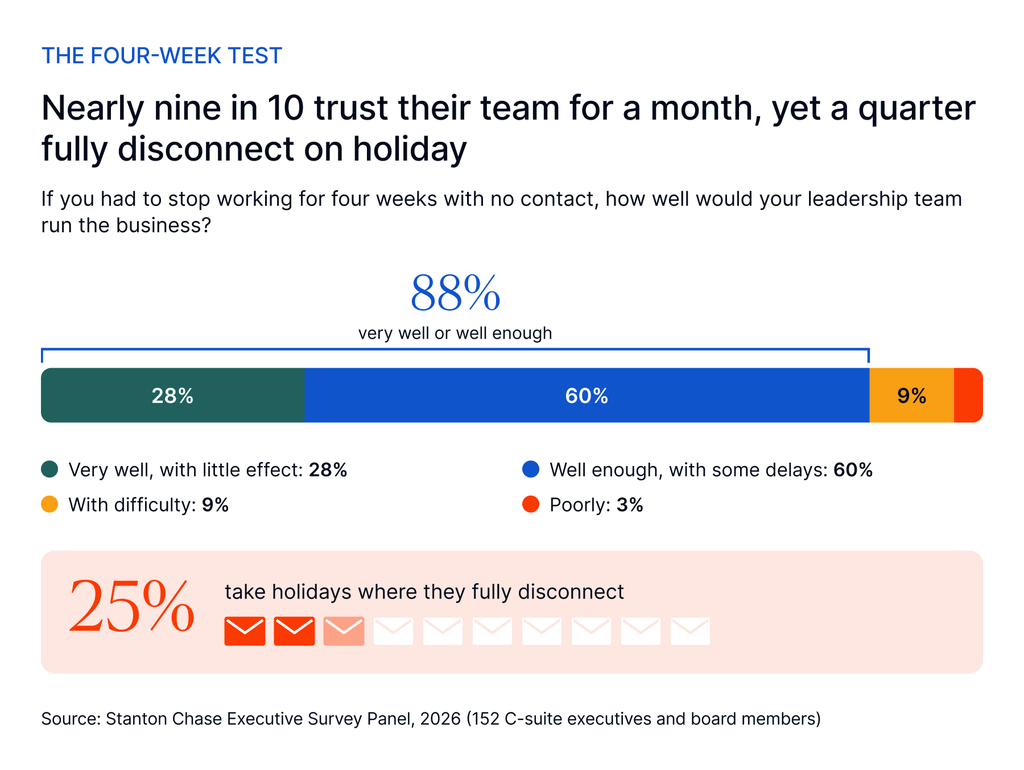
Stepping away was the subject of our final question. The answers surprised us. We asked respondents how well their leadership team would run the business if they stopped working for four weeks with no contact. Confidence was high. Some 28% said very well, with little effect, and 60% said well enough, with some delays. Only 12% expected difficulty or a poor result.
Set that confidence next to holiday habits and a mismatch appears. Of the 88% who believe their team would cope, only 27% fully disconnect on holiday. Among the most confident, 60% still do not fully switch off. They trust their team with a month of their absence, yet fewer than a third give it the chance.
Checking in from a holiday cuts into a leader’s own recovery and can affect the team as well. A 2025 meta-analysis of 32 studies in the Journal of Applied Psychology, reported by the British Psychological Society, found that people who mentally detached from work gained the most well-being from a holiday, that exercise helped more than any other activity, and that the benefits lasted at least three weeks after people went back to work. Leaders also set the tone for their teams. In a diary study of 175 employees, research from IMD published in February 2025 found that, of three leadership behaviors studied, respect for boundaries mattered most for whether employees mentally detached from work in the evening.
The coming holiday break is a good time to let those confident teams prove themselves. CEOs may learn the most. One in five CEOs in our survey (20%) expect the business to run with difficulty or poorly without them. No board member said the same. For those CEOs, a fully disconnected break is an early test of the team before 2027 begins.
How Can Executives Protect Their Resilience Over the Holidays?
Our findings and the research above suggest five practical steps.
- Name a deputy for each area of decision-making and tell the team who holds it, so questions have somewhere to go besides your phone.
- Agree in advance what counts as urgent enough to call you, and keep that list short.
- Turn off email and messaging notifications for the full break, including the days around public holidays.
- Plan exercise and time with family and friends, the two habits our respondents rely on most. Exercise also did the most for holiday recovery in the research above.
- When you return, ask what your team handled without you, and use the answer to decide where your leadership team needs support in 2027.
About the Survey
Stanton Chase ran this survey from October 20 to November 19, 2026, among members of its Executive Survey Panel, a group of selected C-suite executives and board members whose views inform the firm’s research. Of the 152 who took part, 34% were chief executives, including presidents and managing directors, and 17% were board chairs or non-executive board members. All responses were anonymous. Percentages are rounded, and respondents could choose more than one answer on some questions.
How Can We Help?
At Stanton Chase, we're more than just an executive search and leadership consulting firm. We're your partner in leadership.
Our approach is different. We believe in customized and personal executive search, executive assessment, board services, succession planning, and leadership onboarding support.
We believe in your potential to achieve greatness and we'll do everything we can to help you get there.
View All Services