




As many CEOs spend more of their time with investors, regulators, boards, and other outside parties, COOs are taking over more of the day-to-day running of the company. Stanton Chase’s Mickey Matthews, Mala Chawla, and Norbert Nagy explain how that has widened the COO search brief in the United States, Europe, India, and Southeast Asia, adding transformation, data and AI, risk, board communication, and growth to the role. In Central and Eastern Europe, founder-led and private-equity-backed companies are also turning to a COO to make the business less dependent on its founder. The article also covers what COO candidates ask about authority before accepting and how Stanton Chase assesses them. It ends with the skills CEOs and boards now expect of a COO.
As chief executives give more of their time to investors, boards, and regulators, the daily running of the company is often passing to the chief operating officer.
Stanton Chase regularly runs COO searches. Three of the leaders who run them explain what clients now want from a COO. Mickey Matthews, a former Global Chair of the Board who now chairs the firm’s Governance Committee, speaks for the United States. Mala Chawla leads searches in Singapore and India and covers wider Southeast Asia, while Norbert Nagy, Managing Partner in Budapest and Regional Vice President for EMEA, brings the European view. Their markets are far apart, yet all three describe a COO who is hired to run the business alongside the CEO and is expected to drive change as well as keep operations steady. The brief for that role is also wider than the same title carried only a few years ago.
Why Are CEOs Handing More Work to the COO?
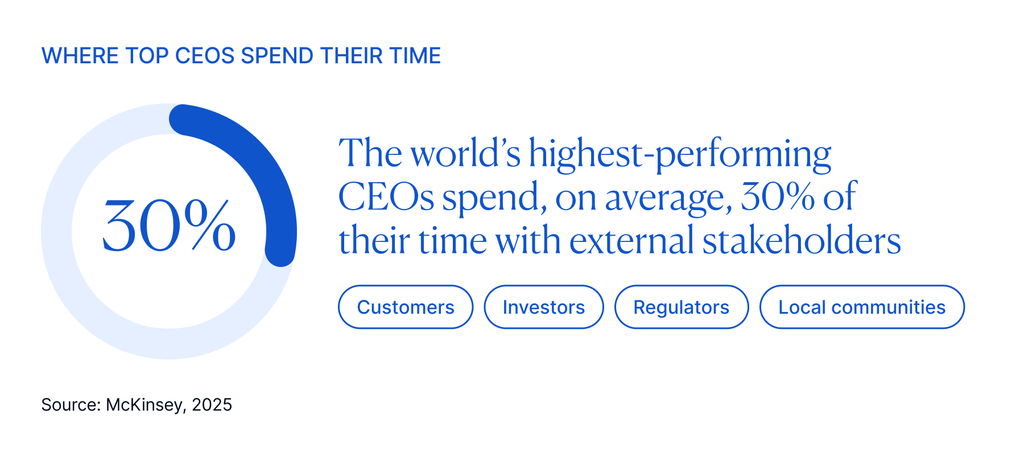
All three trace the wider brief to demands that reach the CEO from outside the company. “CEOs today are pulled into capital markets, regulatory complexity, geopolitical risk, and investor relations in ways that simply didn’t exist a decade ago,” Matthews says. Boards often expect that outside engagement from the chief executive, he adds, in listed and private-equity-backed companies alike. McKinsey reported in 2025 that the world’s highest-performing CEOs spend, on average, 30% of their time with external stakeholders such as customers, investors, regulators, and local communities. With the CEO’s scope increasingly facing outward, somebody has to run the company with discipline.
In Singapore and India, Chawla sees CEOs and COOs dividing the job along the same line. “As businesses grow and become more complex, CEOs focus on growth, investors, the board, and key stakeholders, while COOs take greater ownership of execution and the day-to-day running of the organization,” she says. In India, she links this to a preference for shared leadership. “The Indian mantra of shared leadership is reflected in organizations where a CEO would like to partner with someone who can co-run the business.”
Nagy sees the same division of labor in Europe, where the COO’s remit increasingly extends to coordinating the whole business. When the COO takes on that coordination, he says, “this gives the CEO more capacity for strategy, growth, and external relationships.”
The COO Job Description Now Covers Growth, Technology, Risk, and the Board
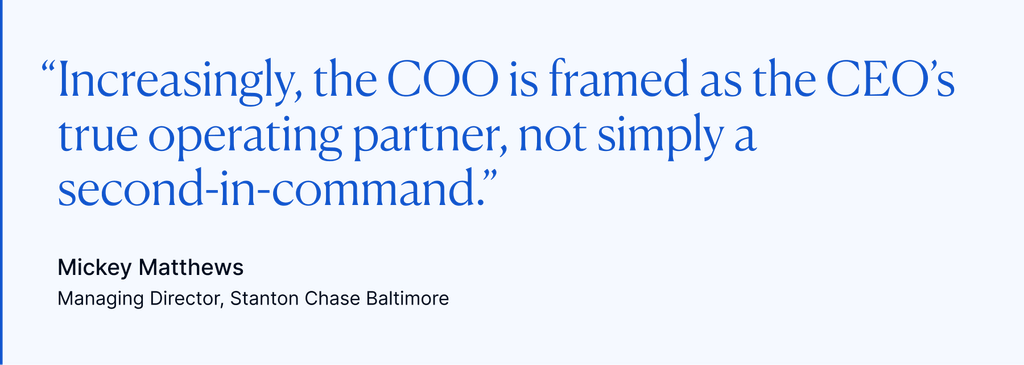
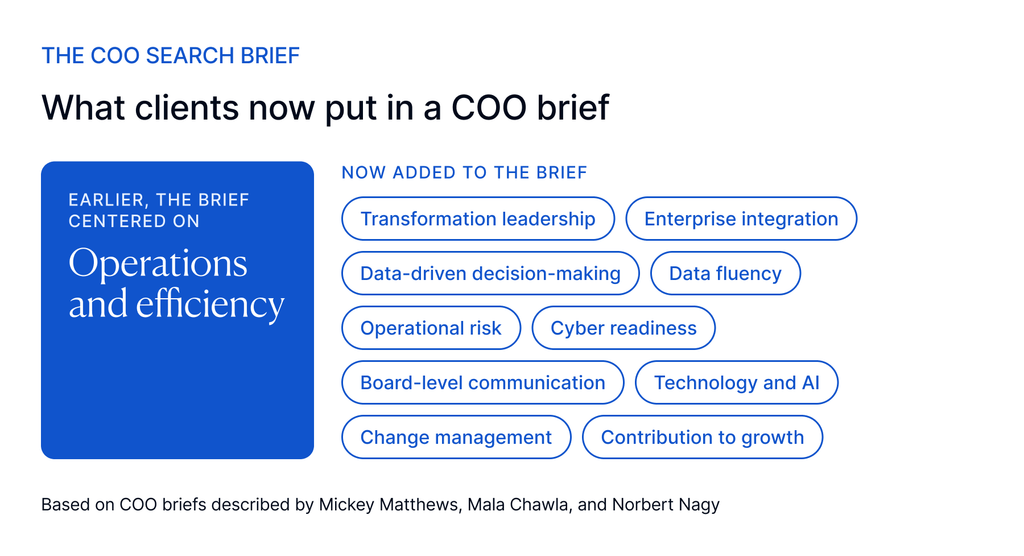
A CEO who wants a partner tends to write a broader search brief. “Earlier, the COO search brief often centered around operations and efficiency,” Chawla recalls. Matthews says his clients now describe the modern COO as the person who “owns the operating engine” of the company. The CEOs he works with want to hand over daily execution and people leadership, along with responsibility for culture and for aligning functions, so that they can give more attention to investors, partnerships, acquisitions, and market positioning. “Increasingly, the COO is framed as the CEO’s true operating partner, not simply a second-in-command,” he says.
A partner to the CEO needs more than operating skill, and the briefs now say so. Matthews says three additions stand out in his clients’ briefs. Transformation leadership is the first, followed by enterprise integration and data-driven decision-making. “I also see far more emphasis on data fluency, operational risk, cyber readiness, and board-level communication,” he says. In private-equity-backed companies, he adds, the COO is expected to professionalize the organization and build systems that can scale.
Chawla’s clients in India and Singapore are asking for much the same, with transformation, technology, AI, organization building, and change management far more visible in their briefs than before. “We also see a clear expectation that the COO will contribute to growth and not just drive operational efficiency,” she says. Nagy’s European clients make a similar point when they spell out that the COO must improve the business while running it. “AI, automation, and data now need to translate into practical outcomes,” he says.
Geography adds one more requirement for companies run from Singapore. “In Singapore and Southeast Asia, there is often an additional layer of complexity because of multiple markets,” says Chawla. The COO is expected to align countries and functions, which moves much of that coordination away from the CEO.
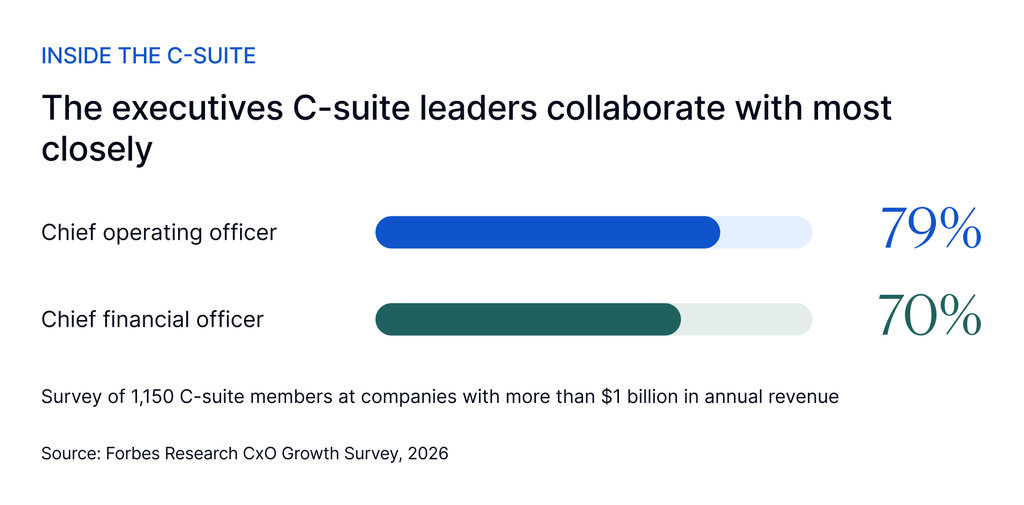
That coordinating role shows in how the rest of the C-suite works with the COO. In the Forbes Research CxO Growth Survey, published in 2026, 1,150 C-suite members at companies with more than $1 billion in annual revenue said they collaborate most closely with the chief operating officer (79%) and the chief financial officer (70%).
Boards are drawing COOs in as well, which fits the board-level communication Matthews mentions. A 2026 McKinsey article on the COO role found that boards increasingly invite COOs into discussions alongside the CEO, particularly on performance and risk and on major transformation efforts. In those discussions, COOs help directors by clarifying feasibility and timing, along with the trade-offs involved.
When Does a Founder-Led Company Need a COO?
Founder-led companies give the COO role a further purpose, and Nagy sees it often in Central and Eastern Europe. “For a founder-led business the need for a COO often becomes clear when too many decisions still depend on the founder,” he says. “A new private equity investor may bring added urgency because the growth plan requires stronger management and more predictable delivery.”
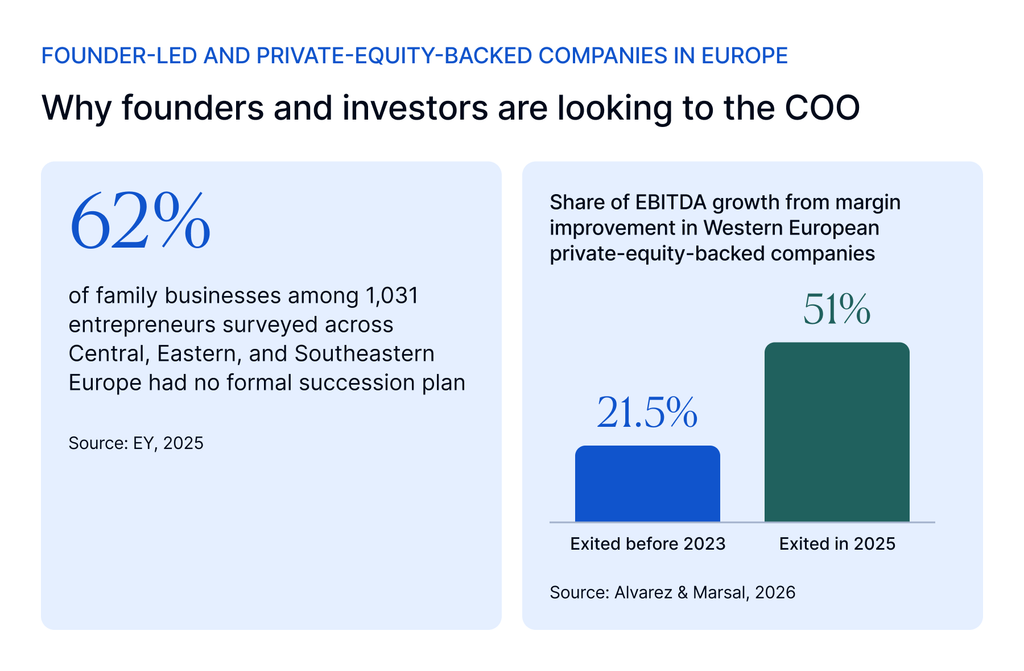
Planning for the founder’s own step back is often informal in the region. When EY surveyed 1,031 entrepreneurs across Central, Eastern, and Southeastern Europe in 2025, 62% of the family businesses among them had no formal succession plan. Nagy says a COO search in that setting has to begin with what the founder is giving up. “The appointment starts with agreeing what the founder will hand over and what the owners expect the COO to achieve. That also determines the right background. A CFO may fit where financial discipline is the priority. An operations leader may be better suited to scaling delivery. A former CEO can fit a broader business leadership mandate.”
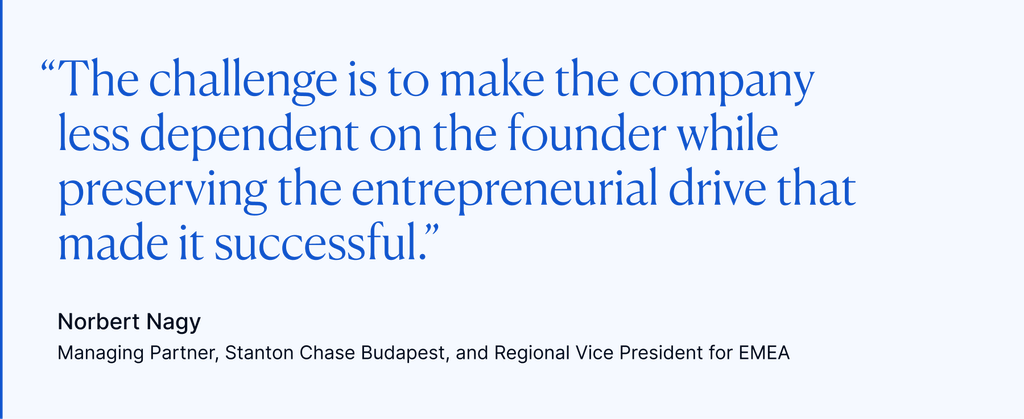
A private equity investor adds a timetable, and Nagy says the brief should then connect directly to the value-creation plan. Those plans now lean more heavily on running the business better. Alvarez & Marsal found that margin improvement accounted for 51% of EBITDA growth in Western European portfolio companies exited in 2025, up from 21.5% for those exited before 2023, and investors elsewhere in Europe are likely to follow the same course. For the COO, that means judging which improvements will pay off within the investment horizon and which build the base for the next stage of growth, without imposing too much structure too soon. “Imposing a large-company model too early can slow the business down,” Nagy says. “The challenge is to make the company less dependent on the founder while preserving the entrepreneurial drive that made it successful.”
What Do COO Candidates Ask Before Accepting the Role?
A brief this wide tends to make experienced candidates careful. “Experienced COO candidates ask very direct questions about authority, decision rights, and whether the CEO is truly ready to delegate,” Matthews says. Because the organization’s purpose and the impact of the role weigh heavily with them, they go on to ask which functions will report to them and how their performance will be measured. They also want to know whether the organization’s culture is ready, and candidates in the United States ask about investment priorities and capital allocation as well.
Chawla hears the same questions about authority, plus one for regional posts. “In Singapore and Southeast Asia, regional candidates also want to understand how much authority they have across markets versus individual country heads,” she says. Her candidates also want to understand the CEO personally, including where the boundaries between the two roles will sit, and they want a path to grow.
At founder-led companies, Nagy hears Matthews’ question about delegation in a sharper form. Candidates want to know whether the founder is ready to hand over decisions and to back ones they might have made differently. Where a private equity firm is also an owner, they want the owners and management to agree on priorities and on when results are due. “A credible role starts with an agreed mandate among the people who will judge its success,” he says.
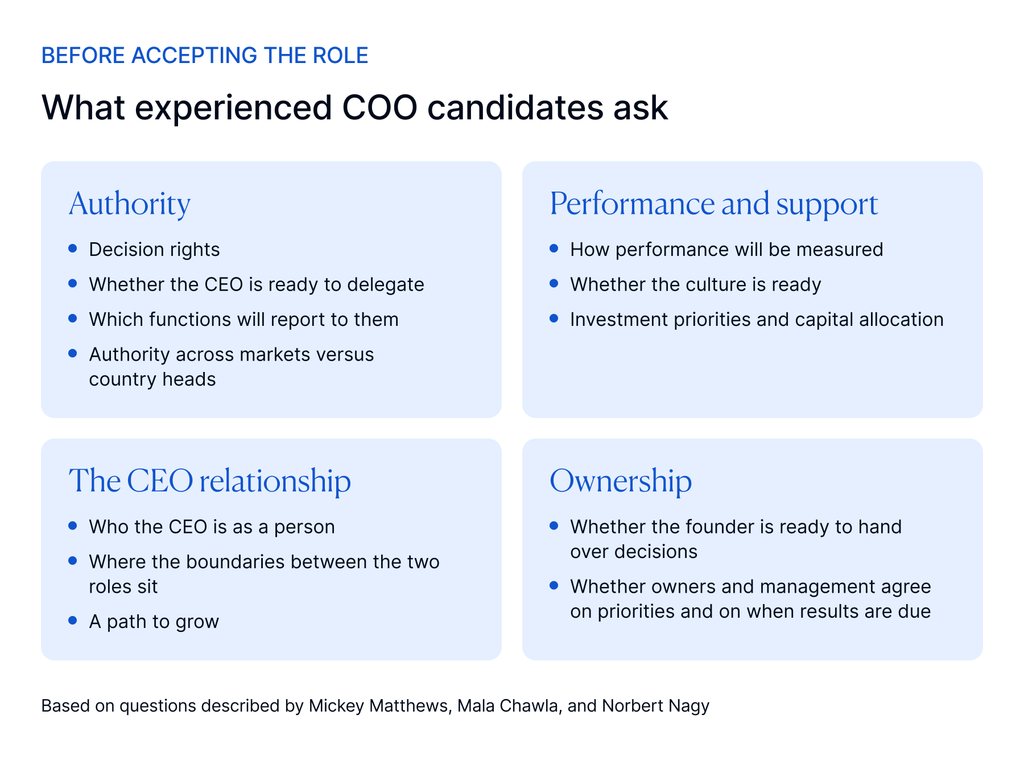
Boards and chief executives preparing a COO search should expect these questions early, so it helps to settle the answers before the first meeting with candidates.
How Stanton Chase Assesses COO Candidates
Stanton Chase assesses every candidate as part of the search. A COO assessment still starts with operating and P&L experience. A larger share of it now deals with the two relationships a COO depends on, one with the CEO and one with the board, and with whether the candidate can build an organization that performs without depending on the COO’s own direct involvement.
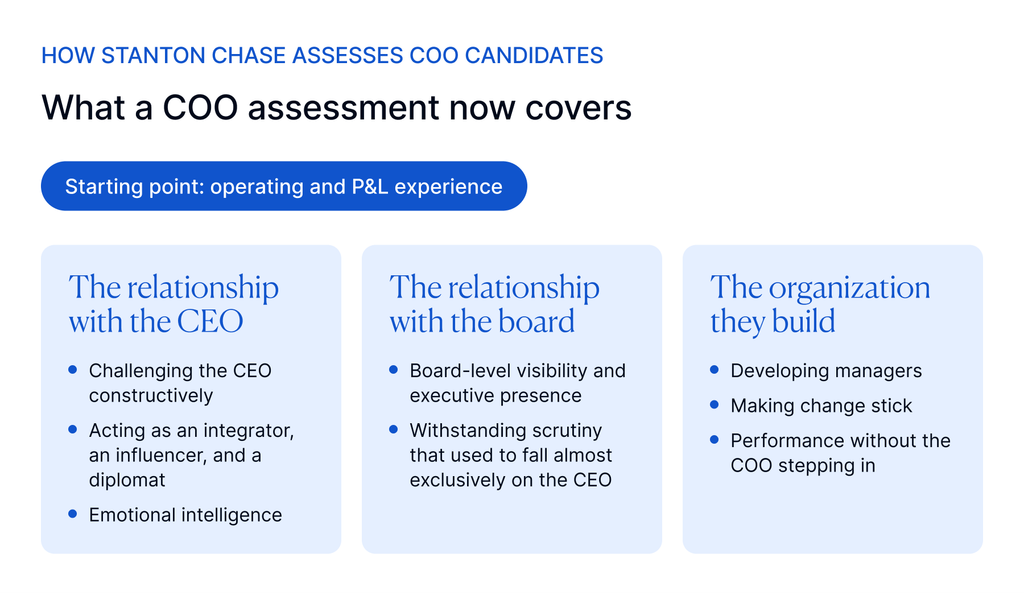
The relationship with the CEO asks a lot of a candidate, since a COO who co-runs the business will sometimes have to disagree with the chief executive. Chawla puts the test as a question. “Would the potential COO challenge the CEO constructively, bring different parts of the organization together, and get things done without creating noise?” Matthews looks for the same quality from another angle. He describes a COO who has to act as an integrator, an influencer, and a diplomat while still operating the business, which is why emotional intelligence carries weight in his assessments.
The relationship with the board is the newer of the two for many COO candidates. “I now assess whether candidates can operate with board-level visibility and executive presence, and withstand scrutiny that used to fall almost exclusively on the CEO,” Matthews says.
Working with a CEO and a board at once calls for range, and Matthews has a phrase for it. “The ability of the COO to zoom out strategically while concurrently zooming in to get scrappy into the details is paramount,” he says. Chawla also weighs each candidate’s potential to grow, since boards often look to their COO when they next appoint a CEO. A 2026 BCG analysis found that COOs made up nearly one-third of 234 CEO appointments in the S&P 500 over the previous five years.
Nagy now gives more weight to the organization a candidate would build. He looks at whether the candidate can develop managers and make change stick, so that the business keeps performing without the COO stepping in. A candidate’s previous title is only a starting point for him. “The decisive question is whether their experience fits this company’s next stage,” he says.
The Skills CEOs and Boards Now Expect of a COO
Operational discipline, execution, P&L experience, and people leadership are still the base of the role and what lets a COO have the impact clients want. On top of them, Matthews, Chawla, and Nagy named the following skills in recent COO briefs and assessments:
- Leading transformation across the enterprise while keeping operations steady
- Fluency in data and AI, and the ability to use both to change how the business operates
- Managing operational risk and cyber readiness
- Building leadership teams and systems that can scale
- Communicating with the board and withstanding its scrutiny
- Aligning functions and, in regional roles, countries
- Challenging the CEO constructively, with the emotional intelligence to keep the partnership working
- Contributing to growth as well as efficiency
- Moving between long-term direction and operational detail
A brief that covers those skills, and settles the questions about authority that candidates are likely to ask, gives a COO search a clear starting point.
About the Authors
Mickey Matthews is a Managing Director at Stanton Chase Baltimore and Chair of the firm’s Governance Committee. He served the maximum of three consecutive two-year terms as Global Chair of the Board. Before that, he was Vice Chair, Practice Groups, and Global Industrial Practice Leader.
His search work is cross-functional and concentrates on global clients in the Industrial and Consumer Products and Services sectors, with senior assignments in general management, business development, operations, and finance. Mickey holds a B.A. in business and economics from Brown University and an Executive MBA from Loyola College in Maryland.
Mala Chawla is a Managing Director at Stanton Chase in India and Singapore. She has advised clients on senior leadership appointments for more than two decades and has helped expand the firm’s presence in both markets.
An engineer by education, Mala began her career in industry before moving into executive search. Her search work centers on Industrial and Consumer Products and Services companies and includes many cross-border assignments. She is also part of the firm’s Inclusive Leadership and Culture practice.
Norbert Nagy is the Managing Partner of Stanton Chase Budapest and Regional Vice President for EMEA, overseeing 30 offices across Europe, the Middle East, and Africa. He has worked in executive search since 2006, with a focus on the Technology, Manufacturing, and Life Sciences and Healthcare sectors, and has led assignments in about a dozen countries.
Before executive search, Norbert worked in the IT industry and in management consulting. He holds a B.A. in Business Studies from Oxford Brookes University.
How Can We Help?
At Stanton Chase, we're more than just an executive search and leadership consulting firm. We're your partner in leadership.
Our approach is different. We believe in customized and personal executive search, executive assessment, board services, succession planning, and leadership onboarding support.
We believe in your potential to achieve greatness and we'll do everything we can to help you get there.
View All Services