


Studies from 2025 and 2026 show that AI can raise the quality of finished work while the skills behind that work weaken unnoticed. In a randomized trial, developers who learned a new tool with AI scored 17% lower on a quiz about it, and a Lancet study found that endoscopists’ detection rate without AI fell from 28.4% to 22.4% after AI tools arrived. For executive assessment, polished output and confident self-reports now reveal less about a leader’s own judgment, so assessors need to test reasoning without tools, the ability to spot errors in AI output, AI habits, and learning agility.
AI can make a leader’s work look better while the judgment behind it grows weaker, so executive assessment has to look past the output to the person.
A board paper used to say a great deal about its author. You could see how they reasoned. You could also see where their grasp of the numbers ran out. Today, an AI tool may have drafted and polished that same paper in under an hour.
Few executives would want to give up that kind of help. Yet it changes what a finished document can tell anyone about its author, because when every memo and forecast looks complete, an employer struggles to know whether the leader could have produced that quality alone or would notice an error the AI introduced.
Research published since 2025 suggests employers are right to question what AI-polished work says about a leader. Studies of doctors and software developers point in one direction. AI can lift the quality of output in the moment while the skill underneath slips. Users often miss the decline.
How Does AI Hide Skills Gaps at Work?
The clearest evidence comes from software, where outcomes are easy to measure. In a randomized trial published by Anthropic in January 2026, 52 developers learned a new Python library. Some used an AI assistant and some worked by hand. On a quiz about concepts they had used minutes earlier, the developers who worked with AI scored 17% lower than those who coded by hand. Debugging questions showed the widest difference.
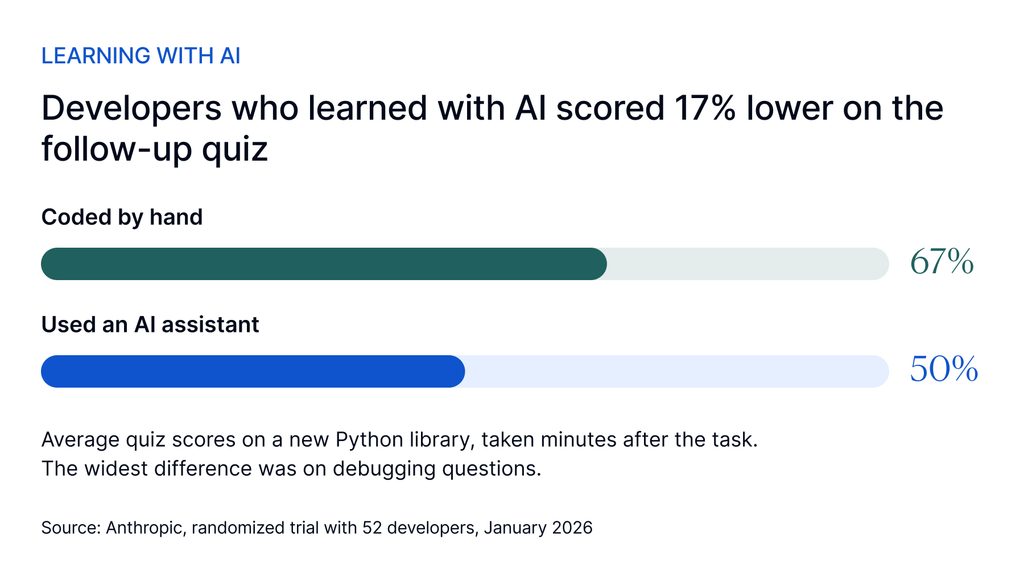
Debugging is the skill people need when a tool gets something wrong. In the boardroom, the equivalent moment arrives when a forecast or a contract summary contains a flaw nobody has flagged. Suppose the leader reading it has handed that kind of checking to AI for months. The flaw may pass straight through.
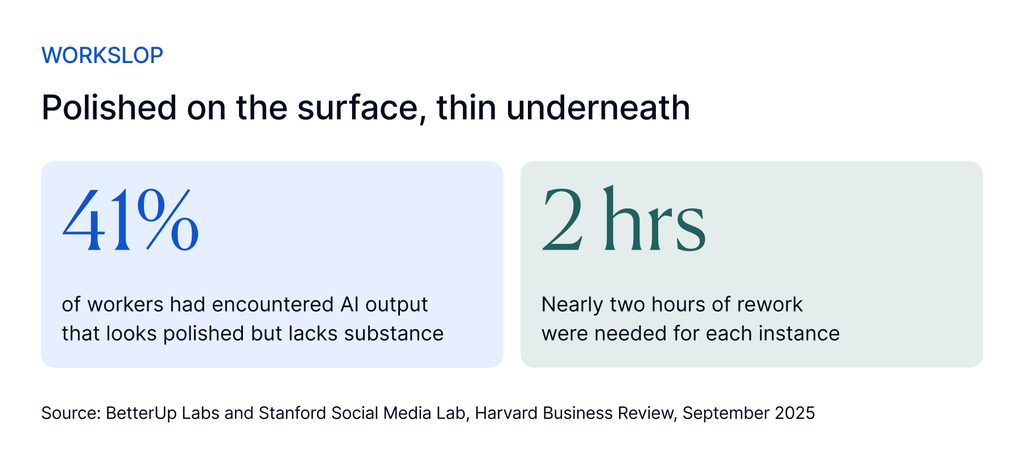
Office work shows a similar pattern. Researchers at BetterUp Labs and Stanford coined the term “workslop” for AI-generated material that looks polished but lacks substance. According to their findings, published in Harvard Business Review, 41% of workers had encountered it, and each instance took nearly two hours of rework. Polish has become cheap to produce, and cheap polish reveals little about the judgment of the sender.
Why Do People Overestimate Their Ability When Using AI?
If the output hides a weakness, you might hope the person would at least notice it in themselves. Research from Aalto University suggests otherwise. About 500 participants tackled logical reasoning tasks from the LSAT. Half of them had ChatGPT to help. Those using AI did better, yet they overestimated their own performance across the board. Higher AI literacy made things worse. People who saw themselves as more AI literate showed even greater overconfidence. The researchers also found that users rarely prompted ChatGPT more than once per question.
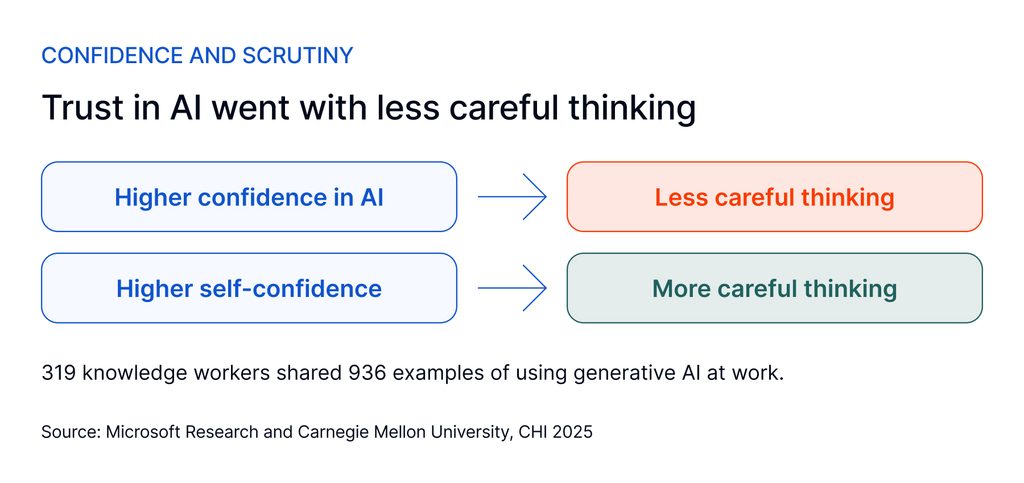
Overconfidence of this kind affects how carefully people check what AI produces. In a survey of 319 knowledge workers, Microsoft Research and Carnegie Mellon University found that higher confidence in AI went with less careful thinking about its output. Higher self-confidence went with more.
Executives are working through the same learning curve, and many admit their teams are not ready. In the Stanton Chase AI in the C-Suite report, which surveyed 214 C-suite executives and board members, 56% cite C-suite AI literacy as one of the top three leadership capabilities lacking for AI transformation. Only 5% said their leadership was “well positioned with no gaps.”
What Happens to Expert Skills When AI Is Switched Off?
Overconfidence would be a minor issue if the underlying skill stayed intact. A study in The Lancet Gastroenterology & Hepatology suggests it can erode within months. Researchers at four endoscopy centers in Poland compared colonoscopies performed without AI in the three months before AI tools arrived with those in the three months after, and the adenoma detection rate fell from 28.4% to 22.4%. The authors concluded that continuous exposure to AI might reduce performance on standard procedures.
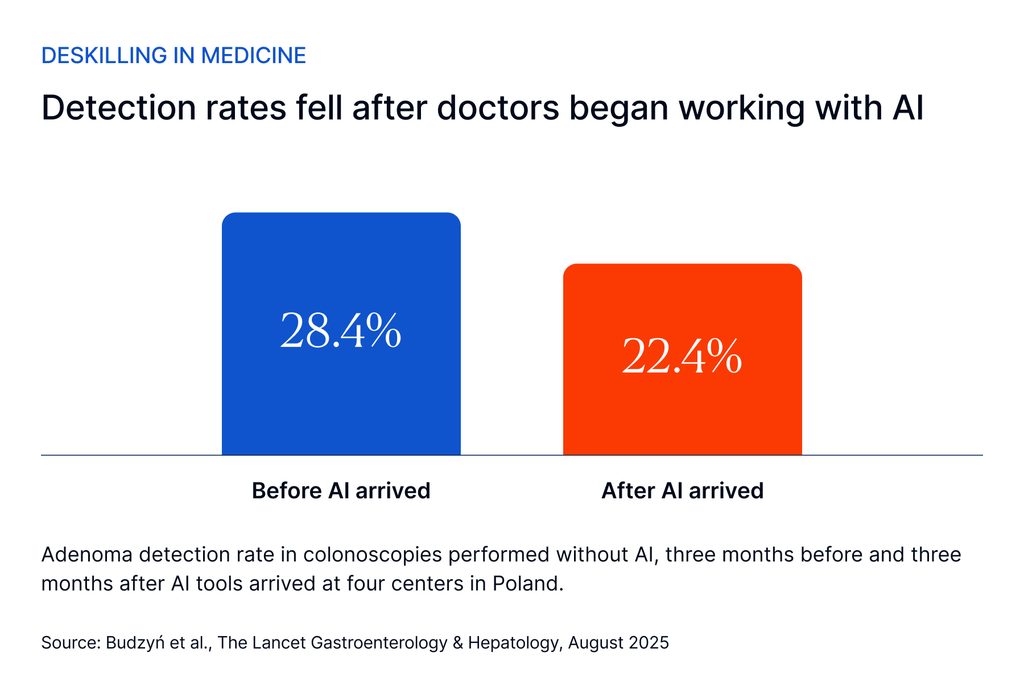
Executives face their own version of this risk. A CFO who lets a model build every forecast may slowly lose a feel for which assumptions are fragile.
Why Must Executive Assessment Change in the Age of AI?
This puts anyone who assesses senior leaders in a difficult position. AI is now part of how executives make business decisions. Deloitte’s 2026 Human Capital Trends report found that 60% of executives regularly use AI to support decisions.
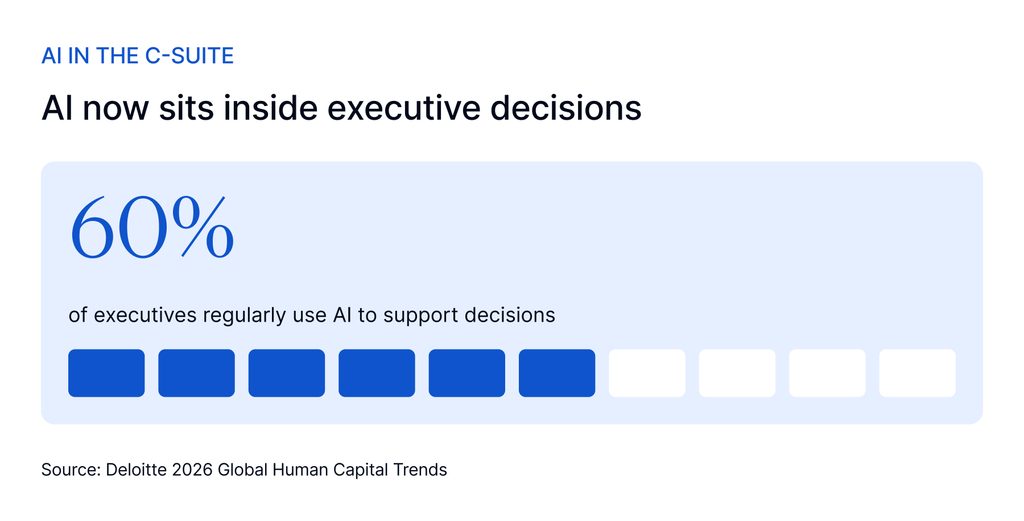
With executives using AI this widely, several kinds of evidence that assessors have long relied on now carry less weight. Written case studies and work samples may reflect the tool as much as the candidate. Self-assessments are harder to trust, since the Aalto University study found that people using AI overestimated their performance, and those who considered themselves more AI literate did so even more.
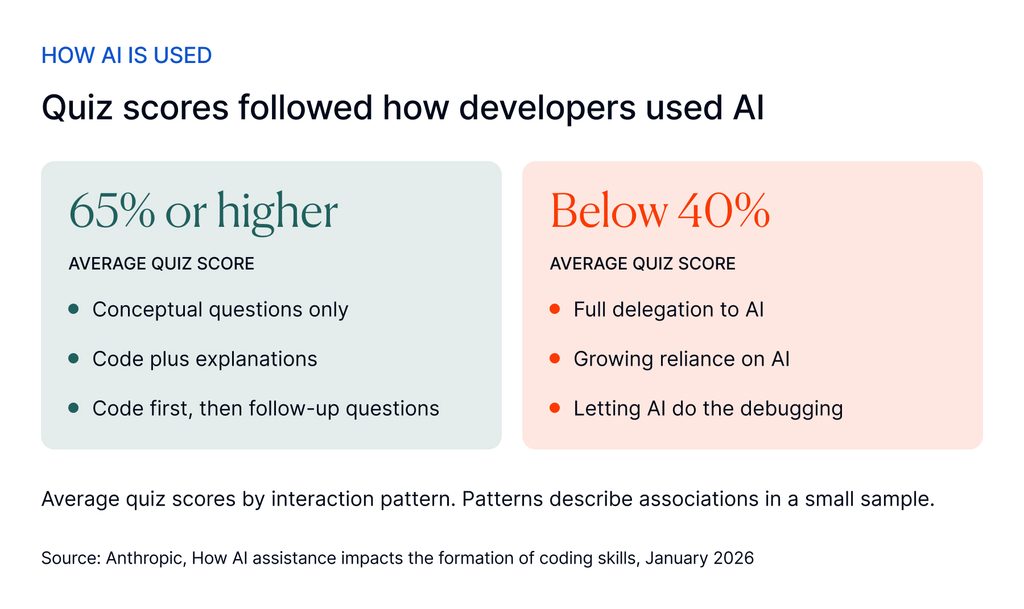
However, it is important to note that using AI does not make executives weaker leaders. In Anthropic’s coding study, scores tracked closely with how people used the tool. Participants who asked AI follow-up questions or requested explanations averaged quiz scores of 65% or higher. Those who leaned on AI to write or fix their code averaged below 40%. So, the way a leader works with AI deserves close attention in any assessment. So does whether they can think without it.
What Should Executive Assessment Measure Now?
Assessors can keep AI in the room and still see the person clearly. Four practices help.
- Start with live reasoning. A conversation about a business problem, with incomplete information and pointed follow-up questions, shows how a candidate thinks when nothing is drafting on their behalf.
- Error-spotting exercises come next. Give the candidate an AI-drafted analysis that contains a few planted mistakes, such as a fragile assumption or a figure that does not add up. Which ones they find, and how they explain them, says a lot about the judgment they would bring to a board paper.
- Watch how the person uses AI on a realistic task as well. Leaders who question the output and ask for its reasoning tend to keep learning. Those who accept the first answer may be giving away the very judgment the role requires.
- Give agility as much weight as current ability. As AI tools keep changing, a leader’s capacity to learn something new, and to understand it instead of outsourcing it, tells a board more about the years ahead than a list of present skills.
How Does Stanton Chase Use Data in Executive Assessment?
These practices fit within Stanton Chase executive assessment, which draws on several kinds of evidence instead of one. Each engagement starts by mapping the role so that the assessment framework reflects what the job will demand. Candidates then complete in-depth interviews, psychometric and cognitive ability tests, business simulations and case studies, and 360-degree feedback. Our framework weighs agility alongside ability and aspiration, and we consider how a new leader will work with the executives already in place.
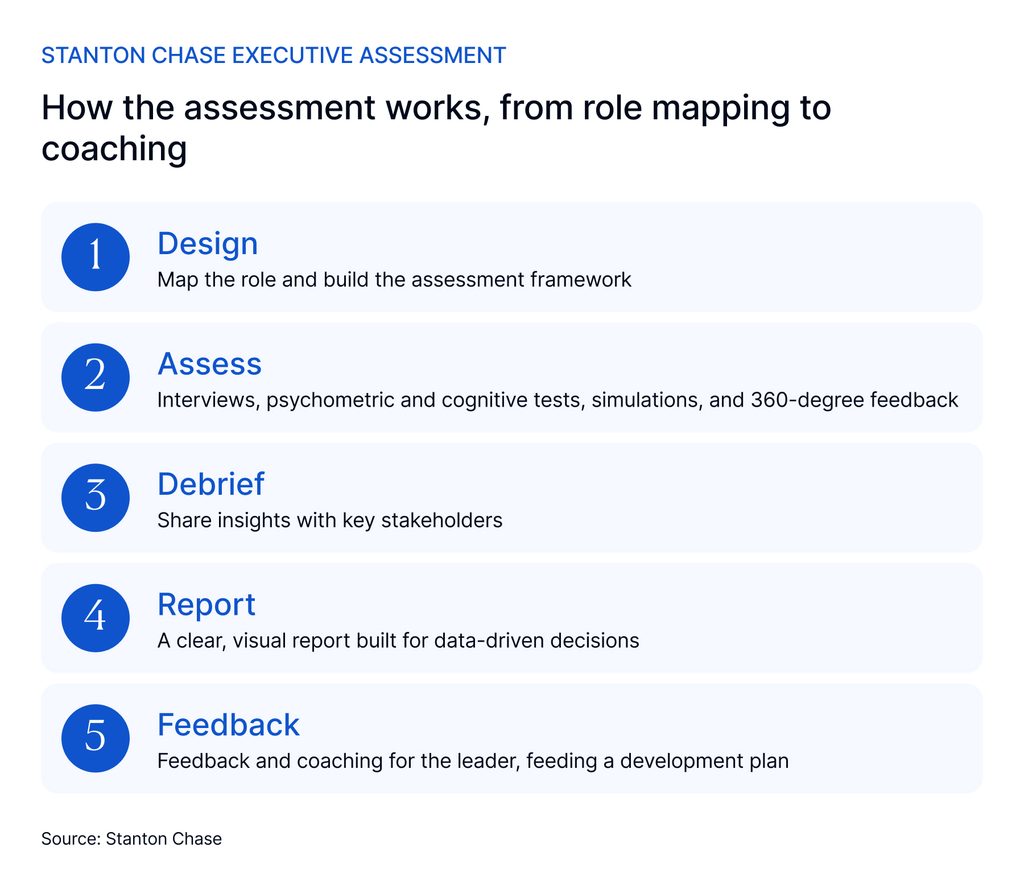
After the assessment, stakeholders receive a debrief and a clear, visual report built for data-driven decisions. The leader receives feedback and coaching that feed into a personal development plan. Boards can then hire and promote with confidence and plan development around the judgment underneath. AI will keep improving how executive work looks on the page. The boards that keep testing what sits beneath it will make better leadership decisions.
About the Author
Kevin McGonigle is a Director at Stanton Chase Atlanta and Global Advisory Leader for Leadership Assessment and Succession Planning. Over his three-decade-long career, he has garnered extensive experience across various industries, including telecommunications, high tech, financial services, hospitality, consumer goods, and industrial. His career spans five continents and includes prominent Fortune 500 companies, private equity firms, and family-controlled businesses.
How Can We Help?
At Stanton Chase, we're more than just an executive search and leadership consulting firm. We're your partner in leadership.
Our approach is different. We believe in customized and personal executive search, executive assessment, board services, succession planning, and leadership onboarding support.
We believe in your potential to achieve greatness and we'll do everything we can to help you get there.
View All Services