


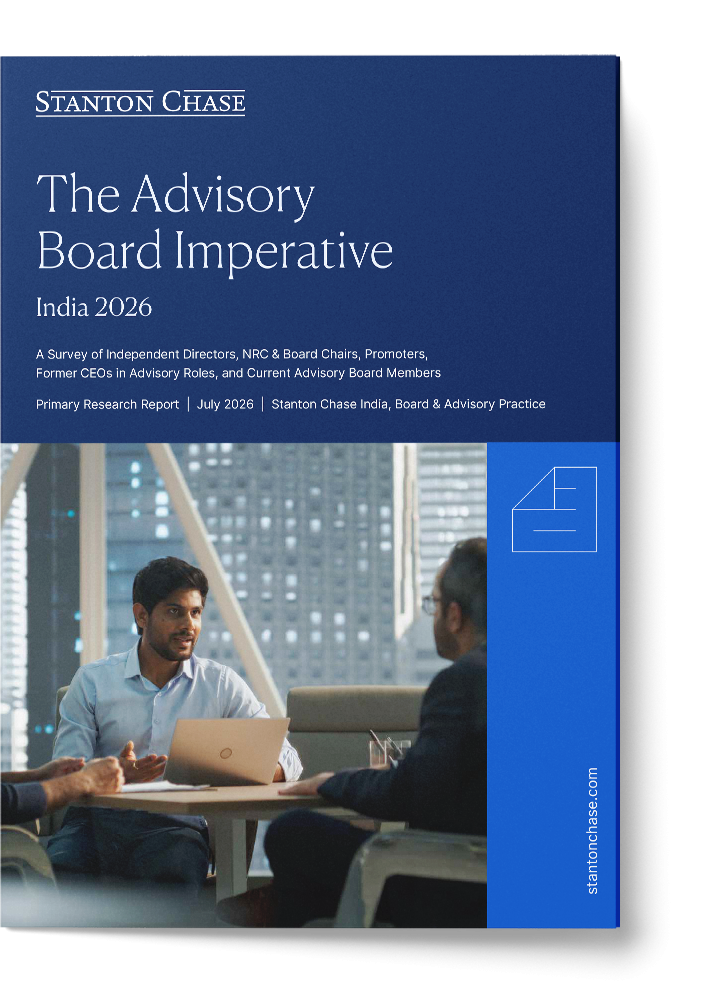
The Stanton Chase India Advisory Board Imperative 2026 surveys independent directors, board chairs and NRC members, promoters and founders, CEOs and CFOs, and serving advisory board members across Technology, Financial Services, Industrial, Pharma, Consumer, Professional Services, and Education organisations. 38% of respondents operate both a statutory and an advisory board and a further 12% run an advisory board alone, with nearly half of those boards formed in the last one to two years. Existing advisory boards rate 7.75 out of 10 on effectiveness, and 82% of operators attribute that value to their willingness to challenge management thinking rather than to network access or credibility signalling. A formal written charter is named as essential by 81% of respondents, and its absence is one of the two most cited reasons advisory boards fail at 54%. Digital transformation and AI is the most cited gap on Indian statutory boards at 42% but is represented on only 41% of existing advisory boards, and 65% identify promoter-led unlisted companies in the ₹100 to ₹5,000 crore band as carrying the greatest unmet need.
Advisory boards in India have moved from concept to common practice faster than the market assumes, and what separates the ones that change decisions from the ones that drift is almost entirely a matter of design.
The Stanton Chase India Advisory Board Imperative 2026 surveys a senior, board-facing cross-section of governance practitioners, including independent directors, board chairs and NRC members, promoters and founders, CEOs and CFOs, and people currently serving on advisory boards. The study establishes, with Indian primary data, how widely advisory boards are being used, what value they deliver where they exist, and what is holding back adoption where they do not.
38% of respondents operate both a statutory and an advisory board, most constituted within the last one to two years, and a further 12% run an advisory board without a statutory one. Where these boards exist they are working, rated 7.75 out of 10 on effectiveness, and 82% of operators attribute that value to their willingness to challenge management thinking rather than to network access or credibility signalling.
The shortfalls are matters of design. Inconsistent advisor engagement and a drifting mandate are each reported by 47% of operators, and 81% name a formal written charter as the essential governance element, the same document whose absence is among the most common reasons advisory boards fail. Among organisations that have not formed one, 56% say current governance is sufficient, and the trigger that converts intent into action is a specific decision such as an acquisition or a market entry.
The report covers statutory board gaps, composition and compensation practice, failure modes, and where the greatest unmet need sits.
Key Findings
- 38% of respondents operate both a statutory and an advisory board, and a further 12% run an advisory board alone.
- Existing advisory boards rate 7.75 out of 10 on effectiveness, and 82% attribute that value to challenging management thinking.
- Digital transformation and AI is the most cited gap on statutory boards at 42%, yet it is represented on only 41% of existing advisory boards.
- A formal written charter is named as essential by 81% of respondents, and its absence is one of the two most cited causes of failure at 54%.
- Inconsistent advisor engagement and an unclear mandate are each reported by 47% of organisations that already run an advisory board.
- 65% identify promoter-led unlisted companies in the ₹100 to ₹5,000 crore band as carrying the greatest unmet need, more than double any other category.
- Respondents rate overall board-level governance quality in Indian companies today at 6.5 out of 10.
Free Download
How Can We Help?
At Stanton Chase, we're more than just an executive search and leadership consulting firm. We're your partner in leadership.
Our approach is different. We believe in customized and personal executive search, executive assessment, board services, succession planning, and leadership onboarding support.
We believe in your potential to achieve greatness and we'll do everything we can to help you get there.
View All Services