


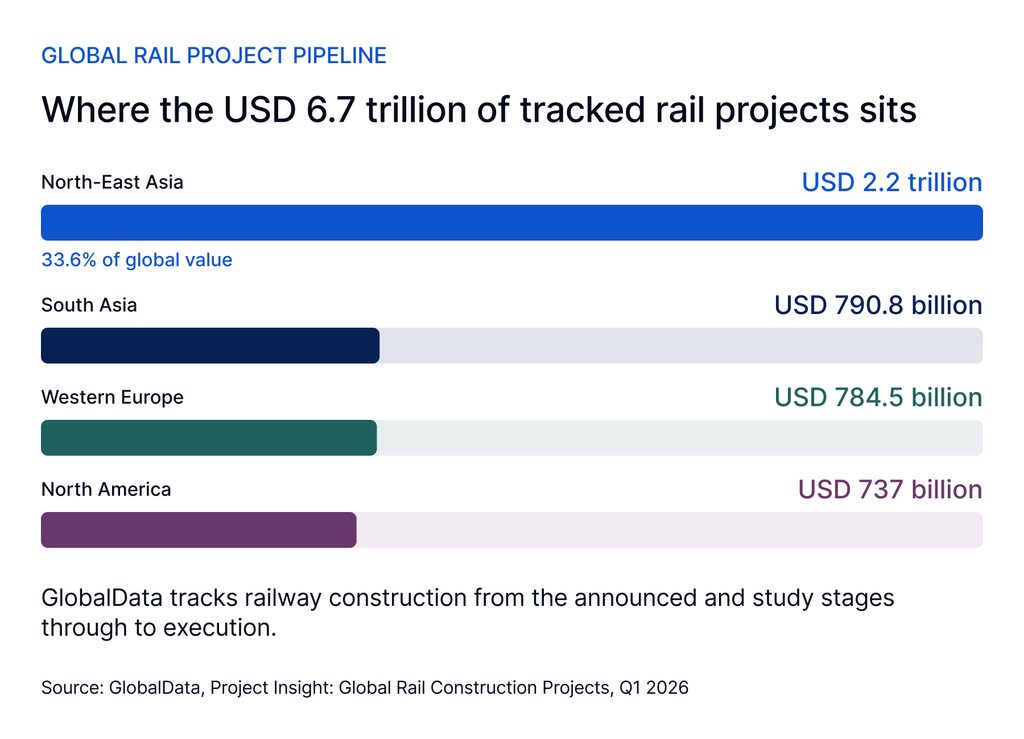
GlobalData tracks around USD 6.7 trillion of railway construction projects worldwide, and PwC estimates USD 14.1 trillion of rail investment by 2050. North-East Asia holds the largest pipeline at 33.6 percent of global value, ahead of South Asia, Western Europe, and North America. China operates 165,000 km of railway and invested RMB 901.5 billion in 2025. The European Commission puts the cost of completing its high-speed network by 2040 at EUR 345 billion. Capital is not the constraint. UITP counts nine million public transport employees worldwide and two million fewer than the sector needs, between 40 and 45 percent of European rail workers are over 50, and the ILO says the sector needs major investment in training, reskilling, and retention. The scarce profile is the executive who can hold together civil engineering, signaling, digital systems, and multi-country stakeholder management.
The railway industry has the largest project pipeline in its modern history, and not enough people to build it.
Rail is being funded as national infrastructure again. The reasons reach well past transport policy. Governments want people moved through crowded cities. They want transport emissions down. They want supply chains that hold when roads and ports fail. The money is already committed. GlobalData tracks around USD 6.7 trillion of projects worldwide. The count runs from the announced and study stages through to execution on site.
The pipeline is lopsided, however. North-East Asia holds 33.6 percent of global value, worth USD 2.2 trillion. South Asia is second at USD 790.8 billion. Western Europe follows at USD 784.5 billion, then North America at USD 737 billion. The longer view is larger still. PwC puts rail investment worldwide at USD 14.1 trillion between now and 2050. Networks will be expanded, renewed, electrified, and digitized over that period.
What Is Driving the Global Railway Investment Cycle?
Four forces account for most of the spending. The first is urban growth. City populations have risen since 1950, the UN projects the trend to continue through 2050, and large metropolitan areas are left with no realistic alternative to high-capacity rail and little room in which to defer the decision.
The second is the condition of what already exists. Mature systems in Europe and North America carry decades of deferred renewal in track, rolling stock, and signaling. A large share of the global pipeline therefore buys back capacity and reliability on existing lines, adding no new route kilometers at all.
The third is freight. Governments are funding corridors they own and control, rather than depending on road networks and ports they do not, and India and Australia are both spending at scale on exactly that.
The fourth is technology. Signaling, train control, predictive maintenance, automation, and cybersecurity now sit at the center of project cost and project risk. None of that is civil engineering. The hiring profile has moved with it. The movement is not recent. The ILO records that over the past 30 years, growth in passenger numbers and freight volumes met competition from road and air, and that combination drove widespread adoption of new technologies and new forms of work organization.
Where Are the Largest Railway Investments Being Made?
China: The World’s Largest Railway Investment Market
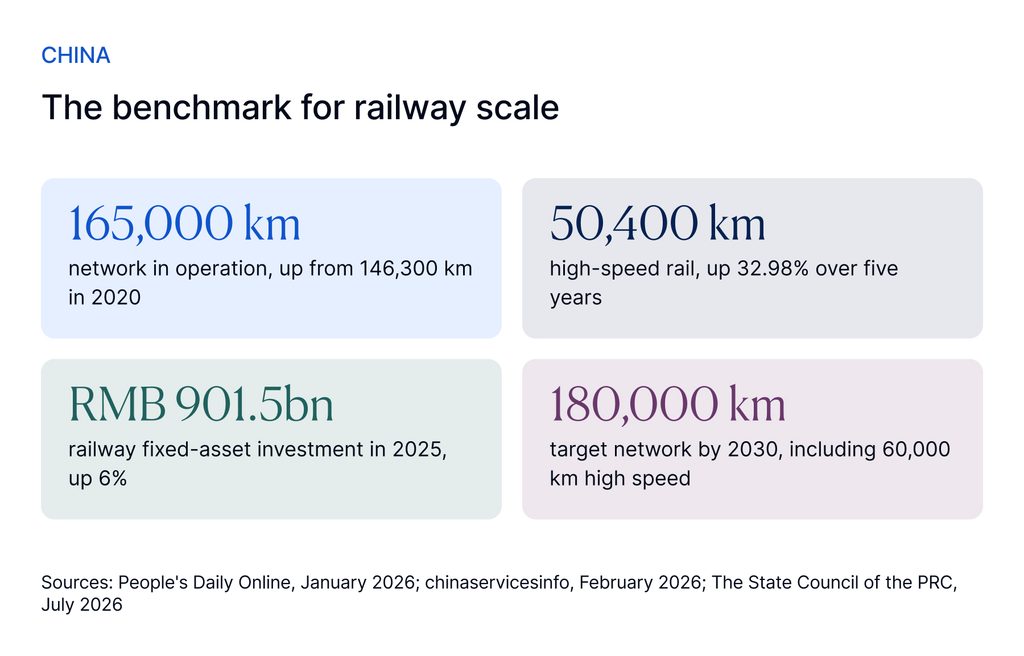
China sets the scale. Other markets get read against it. Its network grew from 146,300 km to 165,000 km over the past five years. High-speed rail rose 32.98 percent to 50,400 km. In 2025 the country opened 3,109 km of new line. Of that, 2,862 km was high speed.
The spending is steady. It is not cyclical. Railway fixed-asset investment reached RMB 901.5 billion in 2025, up 6 percent year on year. The first half of 2026 added RMB 363.2 billion. The target is 180,000 km by 2030. About 60,000 km of that is high speed. China State Railway Group remains the dominant counterparty. For suppliers selling into that market, the hiring question narrows. It comes down to one relationship and the people who can hold it.
India: Freight Corridors and the Mumbai to Ahmedabad Bullet Train
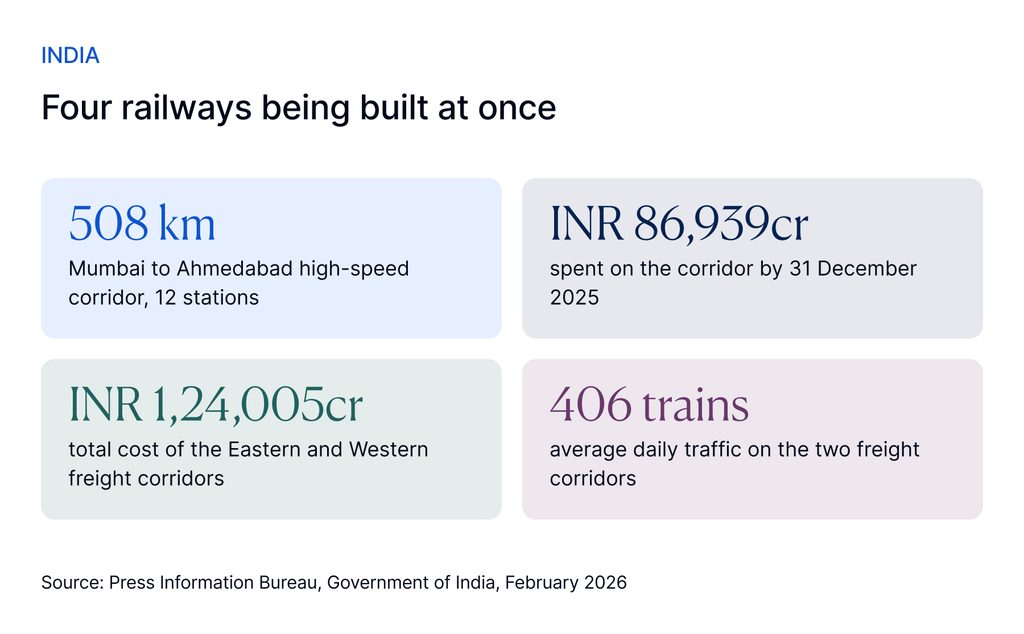
India is interesting for its breadth rather than its scale. Four kinds of railway are in delivery there at once. Conventional intercity rail, dedicated freight corridors, urban metros, and a first high-speed line spread demand across civil works, rolling stock, signaling, and operations instead of concentrating it in one discipline.
The high-speed program is the 508 km Mumbai to Ahmedabad corridor. It is built around 12 stations, with Japanese technical and financial assistance. Indian Railways reports INR 86,939 crore spent by 31 December 2025. Roughly 1,000 Indian engineers and skilled workers have been trained in Japanese methods. Training on that scale is how a country builds its own high-speed workforce. The alternative is renting one, at a premium, for the length of the program.
Freight has absorbed comparable money. The Eastern and Western Dedicated Freight Corridors cost INR 1,24,005 crore in total. The Eastern corridor is complete and commissioned, 1,404 of the Western corridor’s 1,506 route km are now in service, and between them the two lines carry an average of 406 trains every day.
Europe: High-Speed Expansion and the Cost of Interoperability
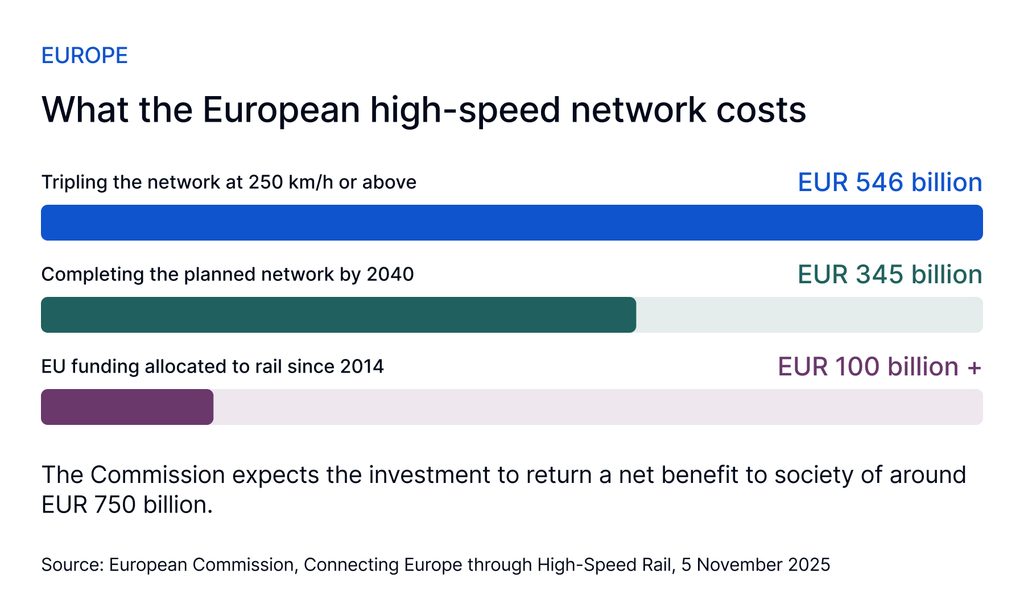
Europe is two markets at once. The first is a high-speed expansion, which the European Commission has now priced at EUR 345 billion to complete the planned network by 2040. Tripling the existing network at 250 km/h or well above would cost EUR 546 billion. The Commission expects a net benefit to society of around EUR 750 billion. EU programs have put more than EUR 100 billion into rail infrastructure since 2014.
Two programs show what that buys. HS2 is the largest single construction program in the UK, running from London Euston to Birmingham Curzon Street and joining the West Coast Main Line at Handsacre Junction, with GBP 25.3 billion confirmed by the government in the 2025 spending review. Civil engineering is about two-thirds complete, and roughly 30,000 people work on the program daily. First services are expected between May 2036 and October 2039. A graduate hired onto the program today would reach mid-career before the first train runs. Rail Baltica links the Baltic states to Poland. It has secured more than EUR 4 billion and moved into large-scale civil works.
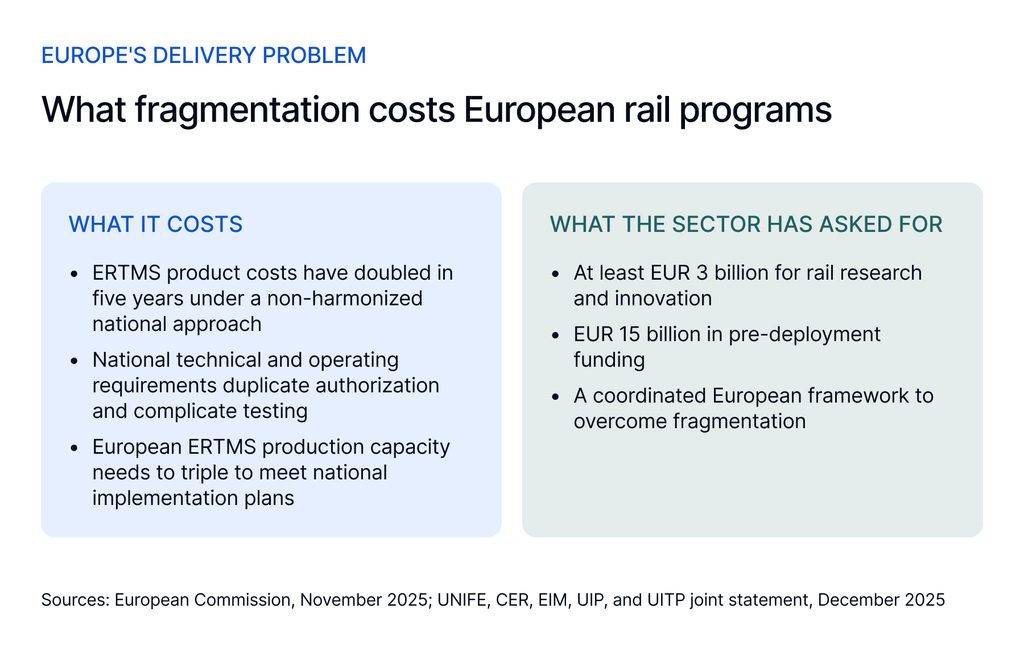
Upgrading what already runs is the second market, and the harder of the two. Europe’s difficulty there is fragmentation, and the Commission is unusually blunt about it. National technical and operating requirements duplicate authorization and complicate testing, which raises cost. A non-harmonized national approach has doubled the price of ERTMS products in five years. National plans now point to tripling Europe’s ERTMS production capacity. In December 2025 the main European rail bodies asked jointly for at least EUR 3 billion for research and innovation. They asked for a further EUR 15 billion in pre-deployment funding. Only a coordinated European framework, they argued, can overcome the fragmentation driving those costs.
For anyone hiring in Europe, that is the heart of the problem. A program director has to deliver across several national rule sets at once, each carrying its own signaling baseline, its own authorization process, its own testing regime, and its own procurement rules, and very few people anywhere have done that more than once.
Middle East: Rail as National Transformation
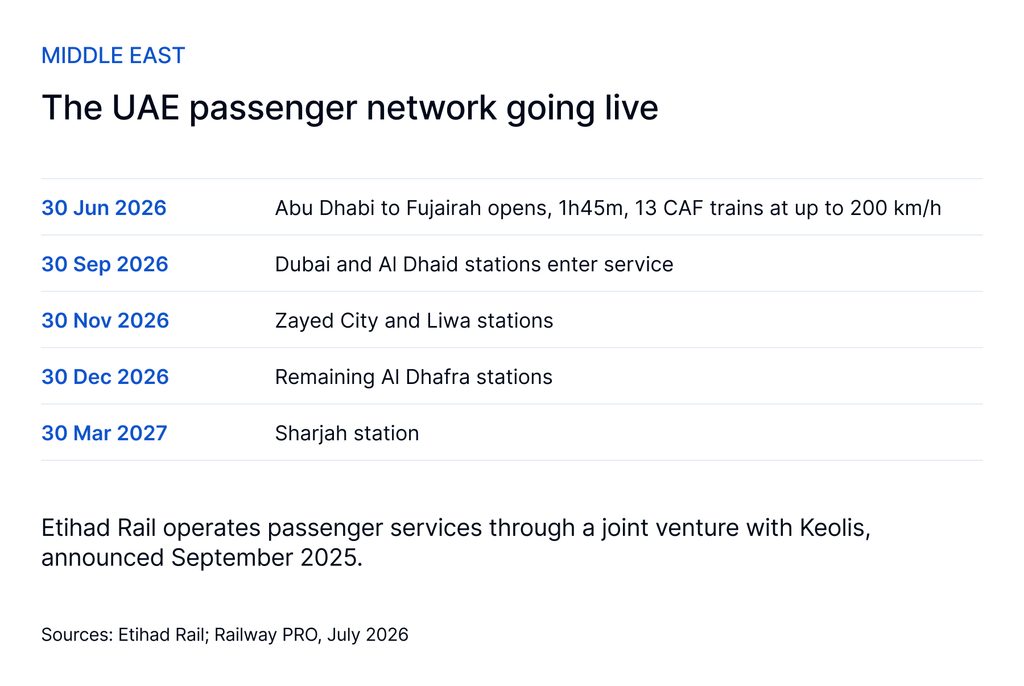
The Gulf has no comparable legacy of national rules to work around, and it has moved fastest from plan to operation. Etihad Rail began UAE passenger services on 30 June 2026. The first route links Abu Dhabi and Fujairah in one hour and 45 minutes, worked by a fleet of 13 CAF trains that each carry more than 360 passengers at speeds of up to 200 km/h. Dubai and Al Dhaid followed on 30 September 2026. Zayed City and Liwa are due on 30 November 2026. Sharjah follows in March 2027.
Who operates a railway is a separate question from who builds it. Etihad Rail formed a joint venture with Keolis to run passenger services. That puts an international operator beside a state infrastructure owner. It creates demand for executives who have worked both sides of that arrangement.
Saudi Arabia starts from a larger base. The kingdom plans to roughly double its network by adding more than 5,000 km of track, the six-line Riyadh Metro is a USD 22.5 billion program covering 176 km and 85 stations, and a planned 1,300 km Landbridge would connect the Red Sea coast to the Arabian Gulf. One policy target explains the urgency. Public transport use in Saudi cities should reach 15 percent by 2030. It sits at 1 percent today. Closing that distance takes operating companies, not track alone. Someone has to run them.
North America: New Passenger Rail and Fleet Renewal
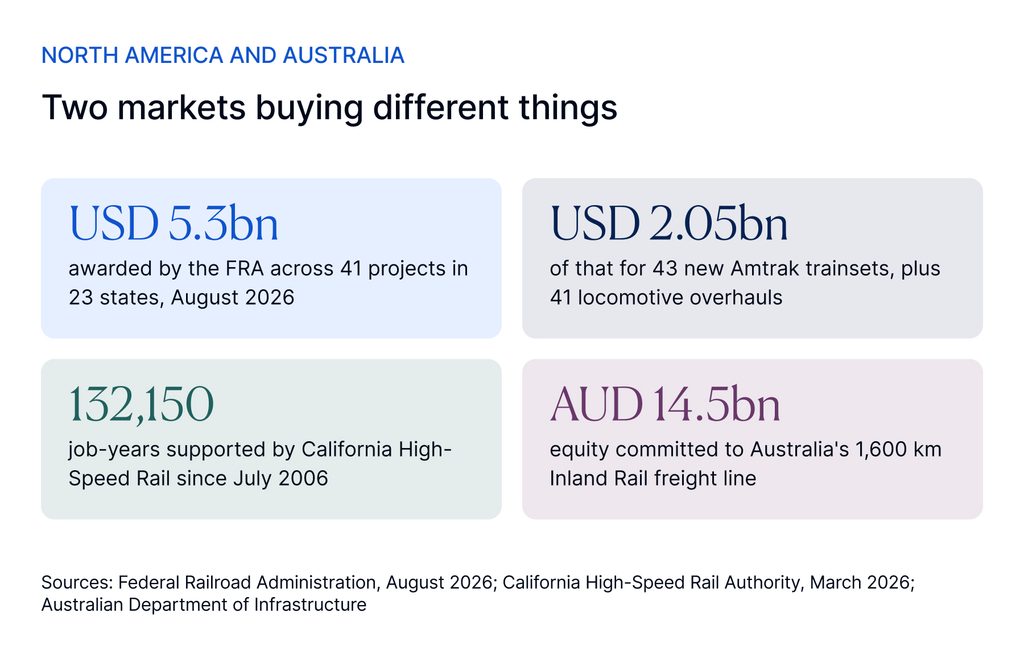
North America’s spending is less visible and more divided. It goes on two things, and only one of them gets attention. California High-Speed Rail is the visible program, with 171 miles under design and construction between Merced and Bakersfield, where in late 2025 the authority launched a USD 3.5 billion procurement covering track, overhead contact system, train control, communications, and safety certification. That one program has absorbed 132,150 job-years since July 2006, with labor income over the period reaching USD 10.5 billion.
The quieter spending goes on track that already exists. In August 2026 the Federal Railroad Administration awarded USD 5.3 billion across 41 projects in 23 states. Amtrak took USD 2.05 billion to buy 43 trainsets. Another USD 140 million covers 41 locomotive overhauls. Grade crossings and fleet renewal make no headlines. They carry the bulk of North American rail hiring in any given year, most of it renewal engineering rather than new-build program leadership.
Australia: Inland Rail and the Freight Spine
Australia belongs in its own category. Its flagship program is freight, not passengers. Inland Rail runs 1,600 km between Beveridge in Victoria and Kagaru in Queensland, funded with up to AUD 14.5 billion in equity plus AUD 290.3 million in grants, with the southern section from Beveridge to Parkes targeted for 2027. It is the clearest current example of a government treating a railway as supply-chain infrastructure rather than as passenger transport. Freight railways are judged on operating cost and reliability rather than on passenger numbers. That puts the premium on operations and asset management. It is a different hire from a passenger program.
Why Is Talent the Railway Industry’s Binding Constraint?
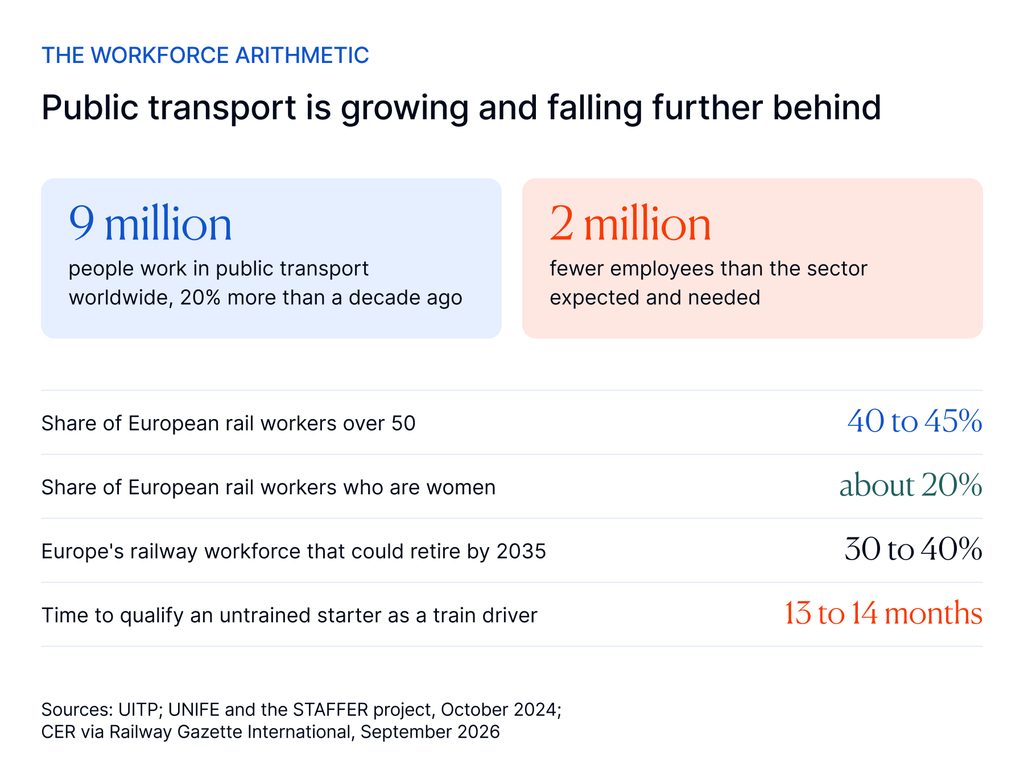
Urban growth, renewal, freight, and technology all rest on the same assumption, which is that the programs they justify can be staffed. The evidence disagrees. UITP counts some nine million people working in public transport worldwide, 20 percent more than a decade ago, and still finds the sector two million employees short of what it expected and needed. Growing the workforce by a fifth has not closed that shortfall. It is a supply problem, not a difficult recruitment year.
Two things explain the shortfall, and the first is age. Between 40 and 45 percent of European rail workers are over 50 years old, and CER has warned that 30 to 40 percent of Europe’s railway workforce could retire by 2035. The second is intake. Women make up only about 20 percent of the European rail workforce, which leaves half the available talent barely drawn on. Replacement is slow even in the most standardized roles. An untrained starter needs 13 to 14 months to qualify as a train driver. Signaling and commissioning expertise take years beyond that.
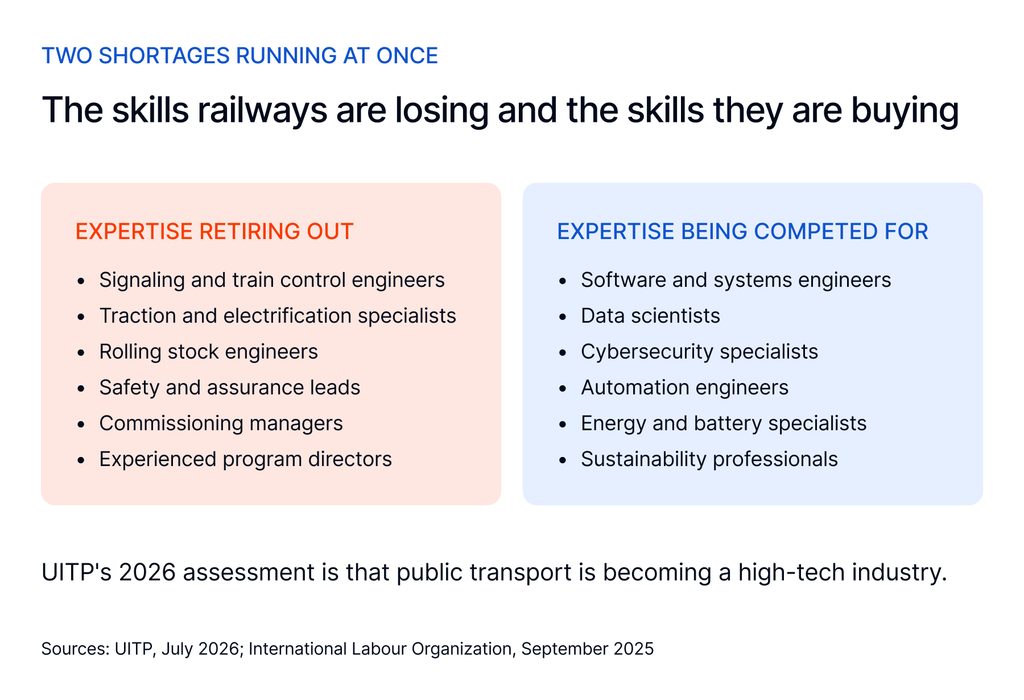
That retirement curve meets a change in what railways buy. UITP’s 2026 assessment is that public transport is becoming a high-tech industry. The sector looks less for traditional transport professions now. It wants maintenance engineers, technicians, data analysts, and digital specialists who can keep a connected railway running.
Established railway expertise is leaving first, held by people retiring with knowledge that was never written down anywhere. Signaling and train control engineers, traction and electrification specialists, rolling stock engineers, safety and assurance leads, commissioning managers, and experienced program directors are all hard to replace at the senior end, and harder still in markets where no comparable railway has been built for a generation. Each departure removes judgment that cannot be documented, only rebuilt, and rebuilding it takes a decade of project exposure.
The newer demand runs alongside that loss rather than after it. Railways now compete for software and systems engineers, data scientists, cybersecurity specialists, automation engineers, energy and battery specialists, and sustainability professionals. They compete mostly against employers who pay more and move faster. The ILO reached the same conclusion in September 2025. A sectoral meeting recommended major investment in training, reskilling, and in attracting and retaining staff. The Commission’s high-speed rail plan says much the same about making rail professions more attractive.
What Does Railway Leadership Require in the Next Decade?
Both shortages point at one hole in the executive market. The hardest leaders to find hold an engineering railway and a digital railway together in one program. UITP puts the requirement plainly for urban rail. Success can only be achieved by addressing planning, design, construction, system integration, testing and certification, operations, maintenance, and customer experience as an integrated whole.
Read that as a job specification. It describes one person, sitting between a civil contractor, a signaling supplier, a software vendor, a regulator, and a government shareholder, keeping a certification program on schedule across all of them. Those executives exist in small numbers. They sit in the few countries that have recently delivered a major railway, they are already employed, and they are rarely looking. In our own searches across rail programs, five profiles are consistently the hardest to fill.
- Program directors who have taken a railway through testing, certification, and entry into service, rather than through construction alone.
- Systems integration leaders who can arbitrate between civil, signaling, rolling stock, and software interfaces when those interfaces conflict.
- Digital and data executives who understand safety assurance, because an unsafe algorithm on a railway is a different problem from an unsafe algorithm elsewhere.
- Operations leaders able to build an operating company from nothing, which is what new national networks in the Gulf require.
- Country and regional leaders who can hold a government shareholder, a regulator, and an international joint venture partner in the same conversation.
What the Railway Investment Cycle Means for Executive Search
The investment case is settled. The delivery case is not. Capital has been committed on timelines measured in decades. The workforce that has to spend it is retiring faster than it is being replaced. The skills now entering the sector are being bid for by industries that pay better. Programs will not fail for lack of funding. They will slip because the program director could not be found in time. Or the integration lead. Or the certification manager who signs the railway into service.
That changes what hiring has to do. Succession planning has to start years before the retirement it covers, because replacing a chief engineer who holds years of network-specific judgment is a two-year project rather than a two-month search. Search has to run across borders, since the handful of people who have delivered a comparable railway are usually sitting in another country, on another program, under contract. And the offer made to a software engineer competes with technology employers, not with other railways. That argument has to be built deliberately rather than assumed.
For boards and investors reviewing a railway program, workforce capability belongs beside cost and schedule. The question is not whether the money is there. It is whether the organization has the people to turn it into a railway, and a hiring plan to find them.
About the Author
Ingo Schmittmann is Managing Director at Stanton Chase Kuala Lumpur and Global Subsector Leader for Aviation and Railways. He brings more than 25 years of experience across the aviation, railway, infrastructure, and engineering industries, having held CFO and General Manager positions spanning sales, manufacturing, and HR. He holds an MBA from Strathclyde University and has worked extensively across Asia and North Africa.
How Can We Help?
At Stanton Chase, we're more than just an executive search and leadership consulting firm. We're your partner in leadership.
Our approach is different. We believe in customized and personal executive search, executive assessment, board services, succession planning, and leadership onboarding support.
We believe in your potential to achieve greatness and we'll do everything we can to help you get there.
View All Services