


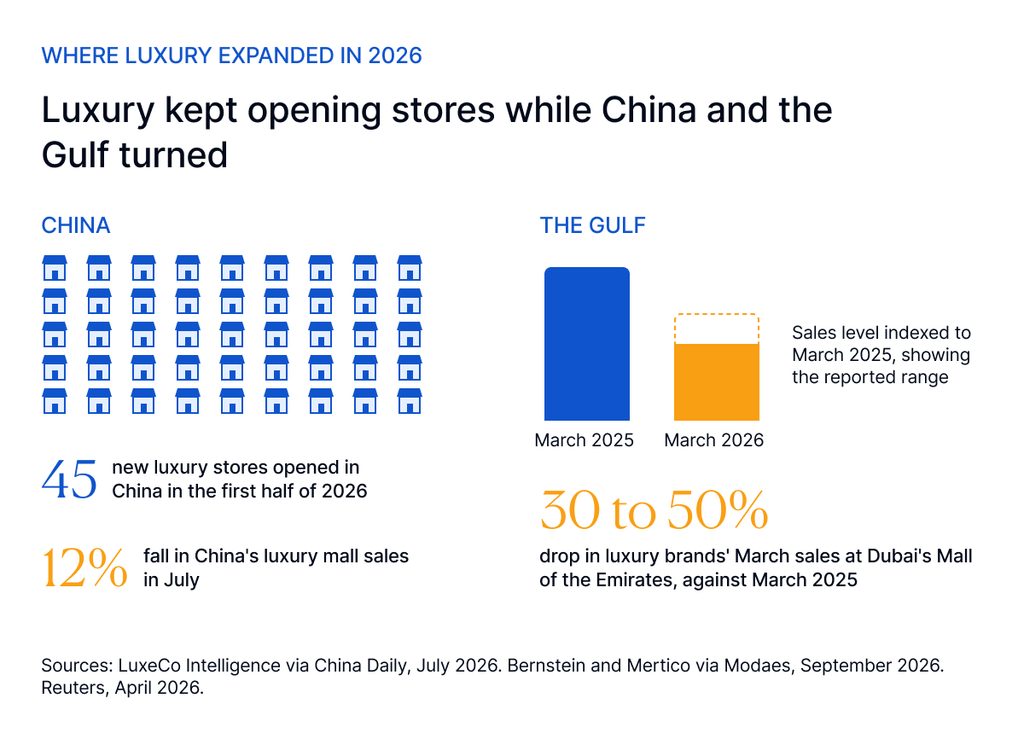
Luxury boards often approve new stores months before they open. Geopolitics can change the business case in between. The Gulf saw this in 2026. Brands had been expanding in the Middle East before the Iran conflict began on February 28, and in March they reported sales drops of 30% to 50% at Dubai’s Mall of the Emirates. The risk reaches beyond luxury. In a 2026 Stanton Chase survey of 112 senior executives across nine industries, geopolitical uncertainty caused 49% of leadership teams to change a decision that had already been approved. Consumer companies feel geopolitics in pricing. Among consumer products and services executives, 67% named pricing as their most affected area. Yet 55% of leadership teams have never run a structured geopolitical stress test. Luxury boards can still approve expansion in unstable markets. Each approval should name the events that would reopen it. Leadership teams should rehearse a live scenario every quarter and review pricing monthly, and each market needs a leader with regional and local market knowledge.
When luxury boards approve expansion in unstable markets, each approval should state what would trigger a review and name the local leader who will respond.
The personal luxury goods market shrank 2% in 2025. Bain & Company expects 2% to 4% growth in 2026. Brands did not wait for that forecast. LuxeCo Intelligence counted 45 new luxury stores in China in the first half of the year, China Daily reported.
Brands had also been expanding in the Middle East. Reuters called the region the sector’s fastest-growing market. Then the Iran conflict began on February 28. In March, luxury brands reported sales drops of 30% to 50% at Dubai’s Mall of the Emirates compared with a year earlier, and footfall at the larger Dubai Mall fell by about half, the same report said.
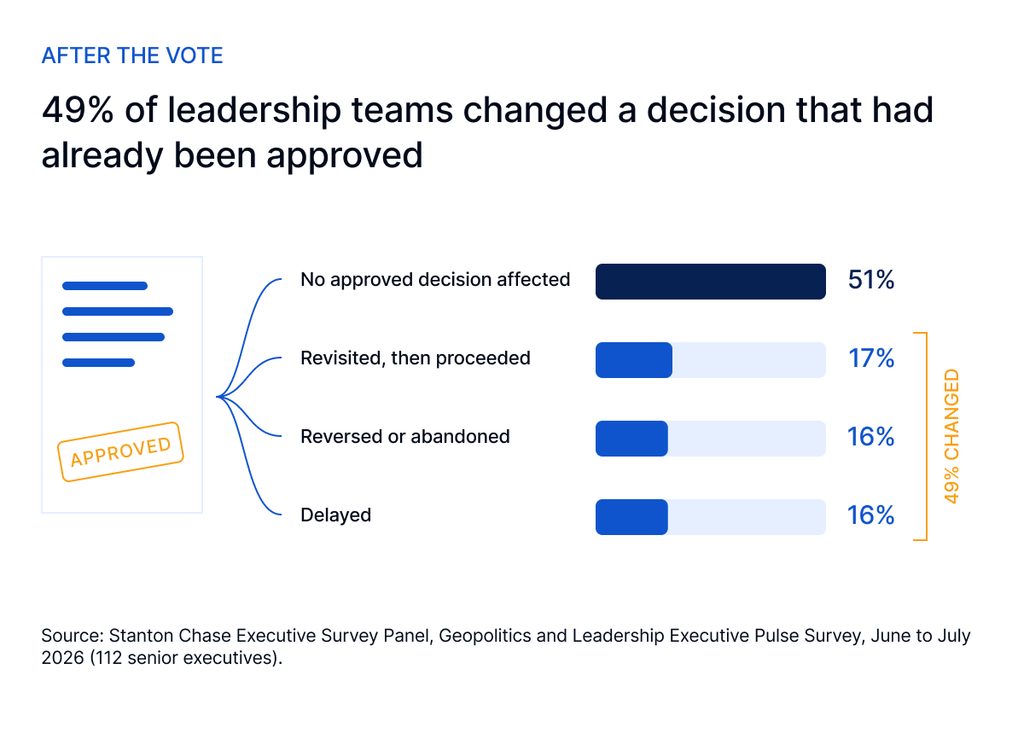
Gulf store plans approved before the Iran conflict suddenly faced a different market. Companies often have to revisit plans like these. In our 2026 survey of 112 senior executives across nine industries, geopolitical uncertainty caused 49% of leadership teams to change a decision that had already been approved.
How Often Does Geopolitical Uncertainty Overturn Approved Decisions?
The full survey report breaks that 49% down further. Across the panel, 16% of leadership teams reversed or abandoned an approved decision, which for a luxury brand could mean walking away from a signed lease on a new boutique. Another 16% delayed a decision. Zoya did exactly that in 2026. The luxury jewelry brand, part of Tata Group’s Titan Company, had planned to open in the UAE, but its business head said those plans were delayed because of war. A further 17% revisited a decision before going ahead anyway. The remaining 51% saw no approved decision affected.
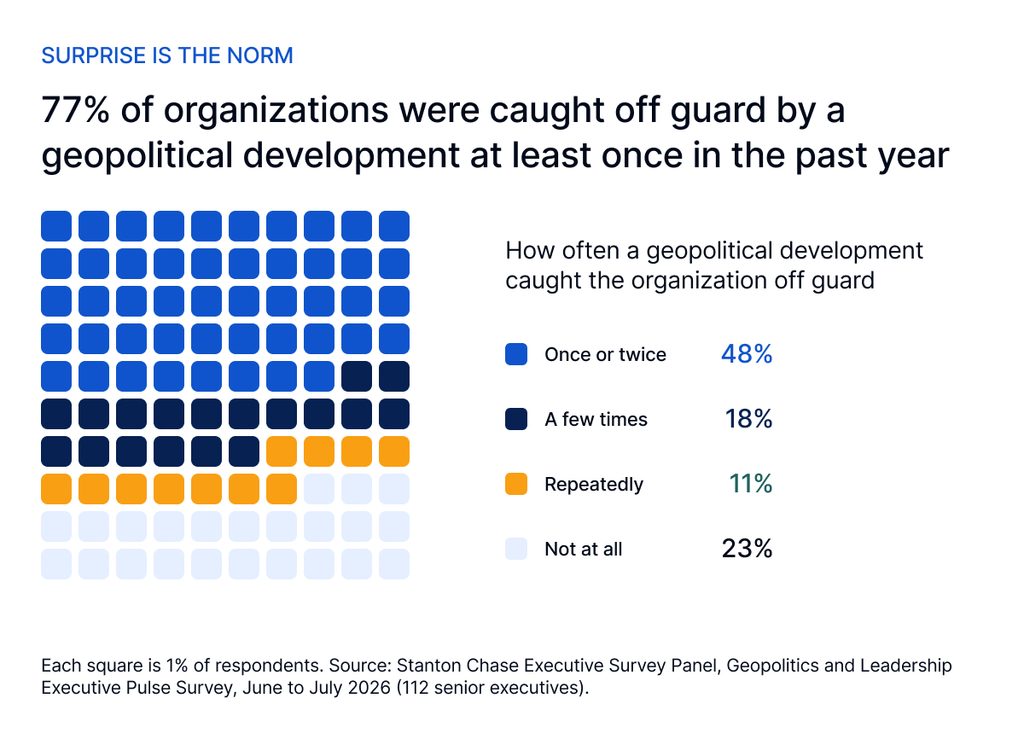
That 49% reflects how often geopolitics surprises leaders. In the 12 months before our survey, 77% of organizations were caught off guard by a geopolitical development at least once. For nearly half (48%), it happened once or twice. Another 18% were caught out a few times, and 11% repeatedly. Only 23% never were.
Luxury brands faced several such surprises in that period. From mid-2025, EU exports to the US faced a 15% tariff, which hit French and Italian groups such as LVMH and Kering hardest, Luxury London reported. Swiss goods, watches included, faced a 39% rate. In January 2026, the US threatened a tariff on eight European countries over Greenland, and luxury stocks fell to a three-month low on January 20. The threat was announced on January 17 and suspended four days later, after Trump spoke at Davos. In February, the US Supreme Court ruled that IEEPA, the emergency powers law behind those tariffs, did not allow the president to impose them. Then came the Iran conflict. Kering temporarily closed its stores in the UAE, Kuwait, Bahrain, and Qatar, Storyboard18 reported.
Expansion plans stay exposed to events like these longer than most decisions. A board usually approves a new store or an acquisition months before the store opens or the deal closes, so a boutique approved in mid-2025 and due to open a year later would have faced every one of these events before opening day.
What Did the Gulf Conflict Show About Knock-On Risk for Luxury Brands?
The Iran conflict hit one of luxury’s most profitable markets. Rents and wages in Dubai were low and prices high, Reuters reported. A source familiar with the Mall of the Emirates told Reuters that megabrands such as Louis Vuitton, Hermès, and Chanel could make several hundred thousand euros a year per square meter there. That was multiple times the global average. The wider region was small but growing. Carole Madjo, head of luxury research at Barclays, put the Middle East at about 5% of global luxury consumption. She said its revenue had grown at double-digit rates in recent years. In January, LVMH’s finance chief said the region was “displaying significant growth.”
Dubai’s luxury trade relied on tourists, however, and the conflict cut them off. Air hubs in Dubai, Doha, and Abu Dhabi closed or ran at reduced capacity, AFP reported. Locals still shopped, a Dubai salesperson told AFP, but fewer tourists did. Bernstein saw wider risks too. In a note cited by Reuters, its analysts warned that higher oil prices, costlier travel, inflation, or a stock market fall could disrupt shoppers’ appetite in other markets as well, particularly the US.
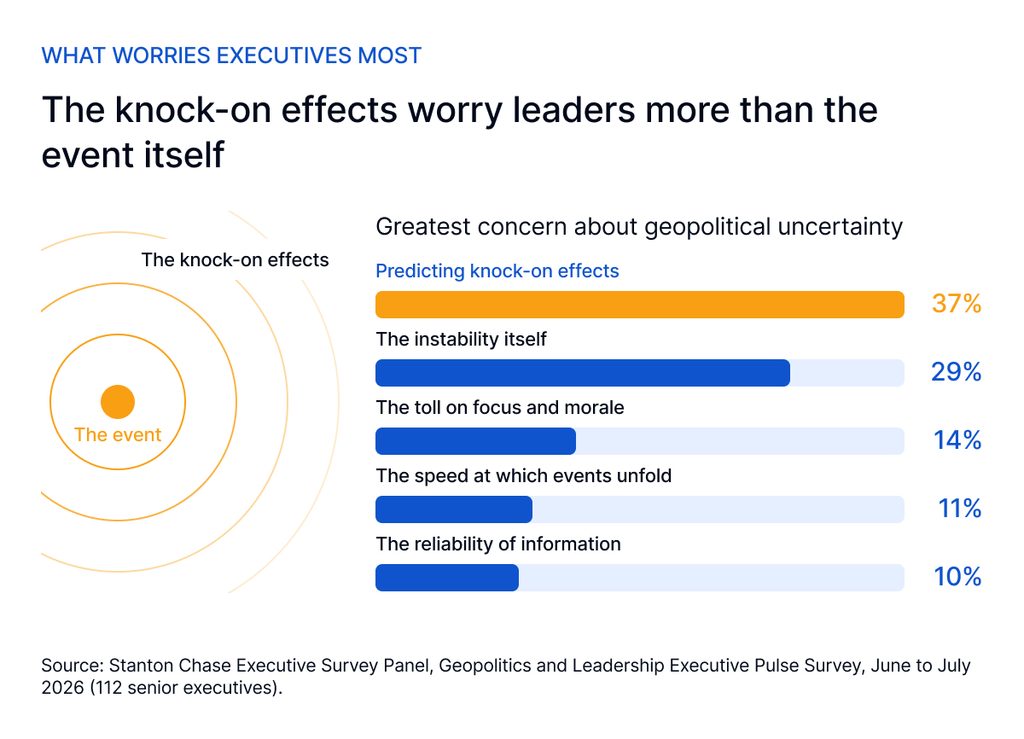
Effects like these are the hardest to plan for. Boards can follow a conflict in the news. Seeing its effect on New York or Paris shoppers is harder. In our survey, 37% said their greatest concern was the difficulty of predicting second-order and knock-on effects, well ahead of instability itself at 29%. Risk leaders feel the same. In PwC’s 2025 Pulse Survey, 48% of risk leaders said the complexity of weighing risks and rewards while managing downstream impacts kept them from communicating risks clearly.
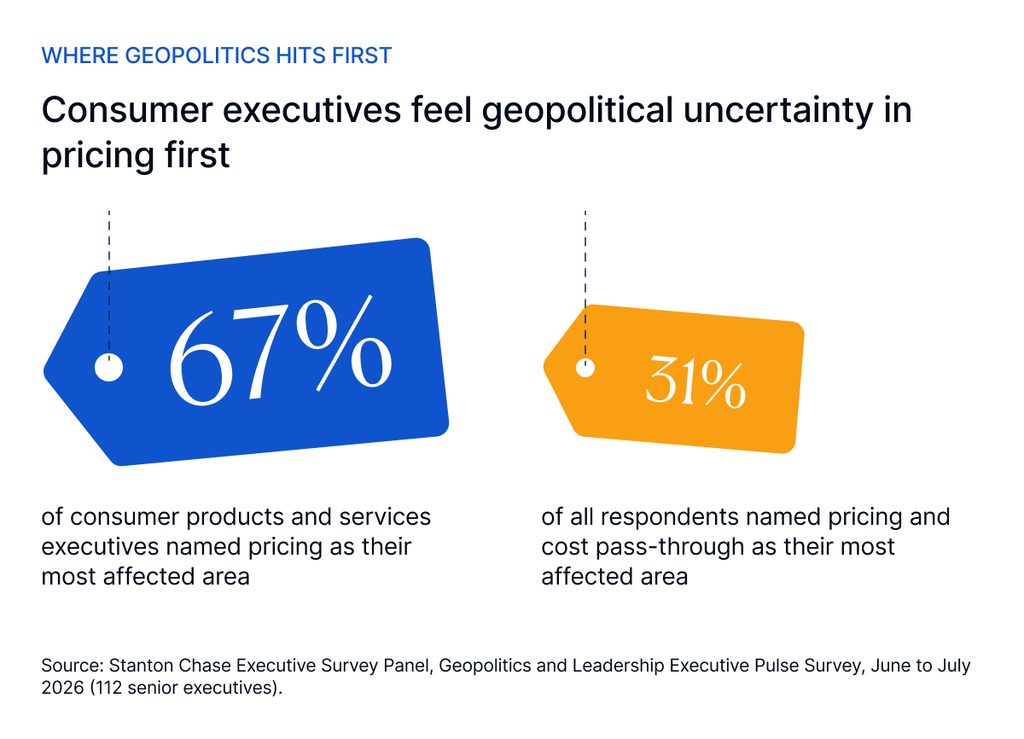
Consumer companies feel those knock-on effects in pricing. In our survey, two in three consumer products and services executives (67%) named pricing as their most affected area. Across all respondents, 31% named pricing and cost pass-through. Some luxury brands have already repriced. When the US imposed a 10% tariff in April 2025, Hermès raised its US prices across all business lines from May 1 to fully offset it, FashionUnited reported. A new store’s business case rests on its prices. Boards should test those price assumptions before they approve.
What Should Luxury Boards Add to Expansion Approvals?
A monthly pricing review is one of four steps that our survey report recommends, and a luxury board can build all four into an expansion approval. Here is how each could work for a new store or acquisition:
- Name the warning signs. List the events that would send the decision back to the board, and name who will watch for them. For an Italian leather house planning US stores, that might mean a higher US tariff on EU goods or a new trade dispute.
- Agree on the decision rules early. Set out what enough certainty looks like and who can make the call. A French jeweler entering India might agree that if India raises its import duty on jewelry, the country head can delay the opening.
- Rehearse before opening day. Once a quarter, run a live scenario through to a decision with named owners. A watch brand opening in New York could test its response to a jump in the US tariff on its goods, like the rise from 10% to 39% that Swiss exporters faced in August 2025.
- Review pricing every month. Give one executive the job of checking pricing and cost pass-through. Treat any margin squeeze as a warning. For a fragrance house that ships to Asia through the Red Sea, the review would show how fast higher freight and insurance costs are reaching its margins.
Quarterly rehearsal, the third step, is the one many teams skip. In our survey, only 16% had run a structured geopolitical stress test in the past three months, and 55% had never run one. Risk teams look similar. In PwC’s Pulse Survey, 45% of risk leaders had done scenario planning. Rehearsal seems to help. In our survey, only 33% of teams fresh from a stress test went on to change an approved decision, against 50% of teams that never rehearsed.
How Can Stanton Chase Help Luxury Boards Plan Expansion?
All four steps depend on the person who will run the new market. That leader usually sees warning signs first. Acting on them often falls to the same person before the board can meet. Choosing that person is where Stanton Chase can help.
Our executive search team looks for leaders who know the market and have run a business through disruption. If the board would rather promote from within, executive assessment can test whether an internal candidate is ready. Once the new leader starts, executive onboarding supports them through the first 100 days.
Boards can also look at their own make-up. Our board services team can review how a board handles these decisions and help it add directors who know its target markets.
If your board plans to expand into a market that has become harder to read, our Consumer Products and Services practice would be glad to talk it through.
About the Author
Miloš Tucaković is Managing Partner of Stanton Chase Belgrade and Global Sector Leader for Consumer Products and Services. He has spent nearly 40 years in HR and management. Twenty of those years were in executive search. His career began in 1985 as a sports journalist at Politika, and in 1990 he joined Hyatt Corporation, where he moved up from a training role to Deputy General Manager and a seat on the executive board. He then led Advance International. For 16 years, Miloš also taught management at Belgrade’s Academy of Applied Studies. He holds a Cornell Executive MBA. Today he coaches CEOs and general managers and is a licensed A&DC assessor.
How Can We Help?
At Stanton Chase, we're more than just an executive search and leadership consulting firm. We're your partner in leadership.
Our approach is different. We believe in customized and personal executive search, executive assessment, board services, succession planning, and leadership onboarding support.
We believe in your potential to achieve greatness and we'll do everything we can to help you get there.
View All Services